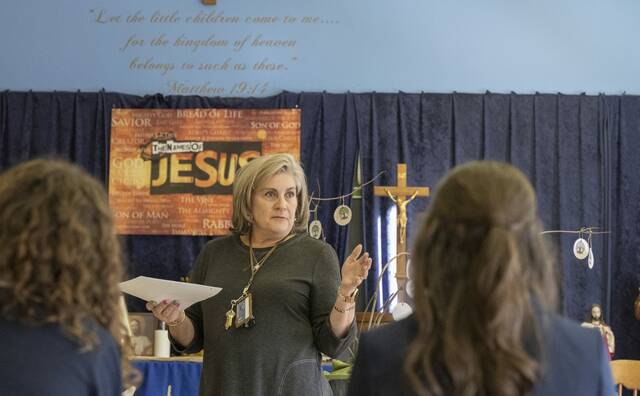

For Leticia Fournier, the religious affiliation of Christ the Divine Teacher School in Latrobe makes education on the Holocaust even more important.
Fournier has taught the school’s Holocaust studies course for eight years. First launched in 2004, the class was a partnership with nearby Beth Israel synagogue, which closed in 2015.
“I think our Catholic school curriculum allows us to pull in the topic easily,” said Fournier, 59, of Latrobe, “because we look at persecutions of Christians, persecutions of Christ and what you can do as a Christian … to help protect other people and speak up.”
Fournier credits her confidence in teaching the subject to Seton Hill’s genocide and Holocaust education program — which will be offered for a third year this spring.
The nine-credit online certificate program — offered for free through the university’s National Catholic Center for Holocaust Education — gives educators strategies for teaching the subject to their students.
The program splits educators into two cohorts — one starting in March and another starting in June. It includes courses on pedagogical methods, a comparative study of 20th century genocides and the role of narrative in Holocaust and genocide education.
The courses count toward the university’s 15-credit certificate in Genocide and Holocaust Studies or a master’s degree in education.
Why it matters
Fournier was one of 15 teachers in the program’s first cohort, assembled in 2024. Last year, 16 educators, teaching grades 6 to 12 in Westmoreland and surrounding counties, participated.
The importance of teaching the Holocaust is simple, Fournier said.
“You have to learn about history so it doesn’t repeat itself,” she said. “We talk about current events and make the students aware that this isn’t just something that happened one time in the past, what they can do as they get older, how they can stand up for other people’s rights and make sure things like that don’t happen again.”
Pennsylvania legislators have taken steps to bolster Holocaust education statewide.
In 2014, lawmakers passed Act 70 — recommending, but not requiring, schools to educate students on the Holocaust, genocide and human rights. A 2017 study by the state Department of Education found that 90% of Pennsylvania’s public and private schools incorporated these topics into their curriculum.
Program connects educators with resources
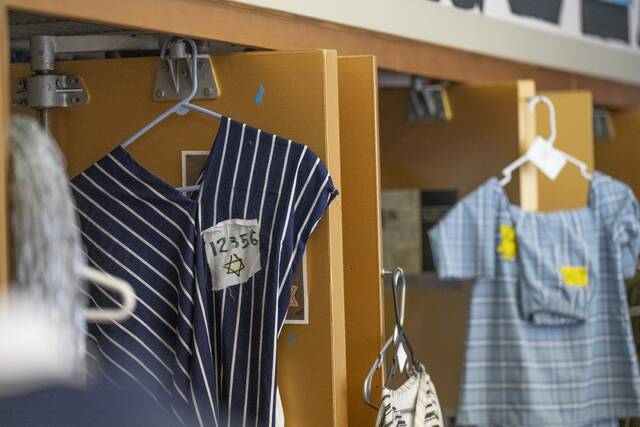
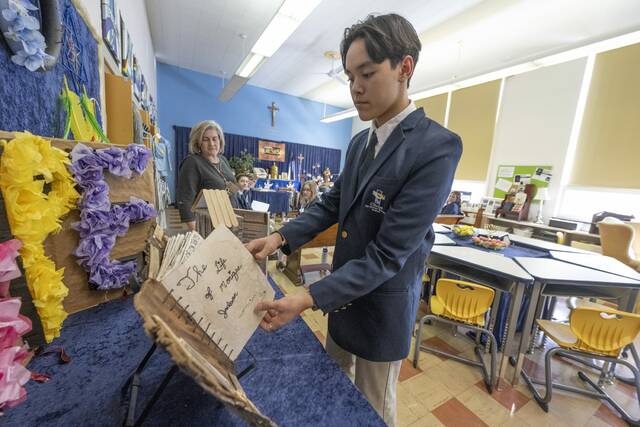
The Seton Hill program’s focus on lesson planning and Holocaust education resources were of particular benefit to Fournier. The book “Salvaged Pages” — a 2002 collection of letters written by young people during the Holocaust — has since become a staple in her classroom.
“I was able to take some of those letters and share them with my kids to give them a firsthand, primary source document that came from somebody who lived during that time period,” she said.
Young people’s perspective on the Holocaust also has been a valuable teaching tool for Indiana Area High School educator Michael Bertig, who completed Seton Hill’s program last year.
Bertig, 40, of Homer City, has taught social studies at the Indiana County high school for 19 years. His 10th grade modern history course covers events from 1900 to the present day, including the Holocaust.
“I think the biggest thing is trying to relate the Holocaust to students’ own experiences,” he said. “And what I mean by that is to make it relatable (by teaching) about young people who actually went through the Holocaust themselves — show students’ journal entries, diary entries.
“Make it very humanizing for them, understanding that these were real people, real children that went through this.”
Bertig benefitted from connecting with other educators and learning their methods of teaching the subject.
“I think those discussions really helped all of us as a group come up with great ways to teach the Holocaust to our students.”
Another 16 teachers are enrolled in the program this year, said university spokesperson Jennifer Reeger. Additional applications are on a waitlist if openings arise.
To receive an application, email jpaharik@setonhill.edu to reach James Paharik, director of the National Catholic Center for Holocaust Education.