Two jailhouse informants testified in Westmoreland County court Monday that, while they were incarcerated together, Thomas G. Stanko confessed to the 2018 killing of Cassandra Gross.
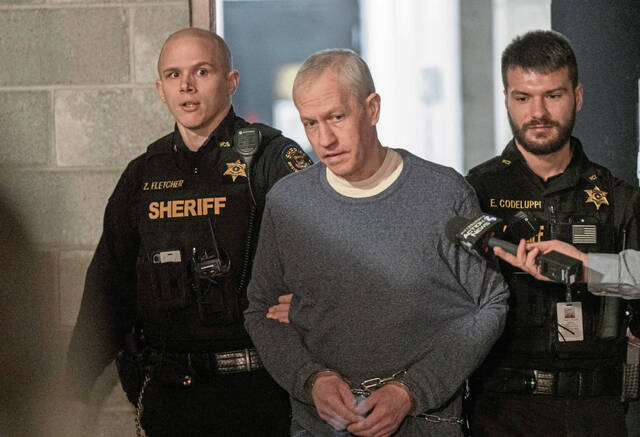
The alleged jailhouse confessions highlighted the sixth day of Stanko’s homicide trial. Stanko, 55, is charged with criminal homicide and reckless burning in connection with the disappearance of Gross, 51. While Gross was legally declared dead in 2019, her remains have never been found. Prosecutors contend Stanko killed Gross following a meeting on April 7, 2018, then burned her body and discarded her remains.
Robert A. Ferrari Jr. was in Westmoreland County Prison awaiting trial on bad checks and forgery charges when he met Stanko. He testified Monday that Stanko was harassed by inmates and jail staff and was taunted with Gross’ name.
One night, Stanko became upset and emotional, punched a table and confessed to killing her, Ferrari told jurors.
“He said, ‘I loved her. She was leaving me, and I didn’t mean to kill her,’ ” Ferrari said Stanko told him.
Ferrari testified he asked Stanko why he burned her vehicle but didn’t kill Gross’ dog, Baxter. The dog was found days later near the charred SUV on a road leading into Twin Lakes Park.
“He said the dog ran away from him. I told him, ‘I guess the dog didn’t like you either,’ ” Ferrari testified.
Albert Sarlouis, 54, was Stanko’s cellmate in 2023 at the Hempfield lockup. He told jurors Stanko overheard him arguing during an online call with a girlfriend he was previously convicted of assaulting. Sarlouis said Stanko became angered over the repeated loud conversations.
“He would tell me to keep it down and then he told me to get rid of her, but I told him I can’t break up with her because I love her. He said I should get rid of her like I did mine,” Sarlouis told jurors.
Stanko then went into more detail, said Sarlouis, who is serving a 2- to 4-year state prison sentence for assaulting a woman. He said Stanko claimed he slapped Gross’ glasses off her face during an argument, then strangled her but didn’t immediately know if she was dead.
“So he stabbed her. He said they will never find her,” Sarlouis testified.
Jurors also heard excerpts of recorded conversations between Stanko and his mother and with another former girlfriend during calls he made from the jail and during in-person visits.
Retired state trooper James McKenzie, in his fourth stint on the witness stand during the trial, testified Stanko questioned his mother about cameras that might have recorded him traveling on an ATV through woods near the Union Cemetery with a shovel.
During a jail visit with his mother in late January 2019, Stanko learned Gross was declared legally dead by a judge.
“I guess that’s the end of me,” Stanko told his mother, according to audio recorded of the visit. “Don’t say that,” Almira Stanko told her son. Stanko replied: “I love you. Sorry Mom. Sorry for being such a wreck.”
Assistant District Attorney Jim Lazar told Judge Michael Stewart II that just one more witnesses is scheduled to testify for the prosecution when the trial resumes Tuesday morning. It is expected Stanko’s former romantic partner will discuss their troubled relationship and threats of violence.
Defense attorney Marc Daffner said no decision has been made about whether Stanko will testify in his defense. The judge said he expects closing arguments and jury deliberations to take place Wednesday.
The case against Stanko has focused on circumstantial evidence.
A series of forensic scientists testified Monday that burned items Stanko discarded from a plastic bag as he fled from police seeking to arrest him on an unrelated case in April 2018 could not be identified. Experts testified none of those items were human remains and at least one small piece of debris had a similar molecular pattern as a glass or plastic object.
Retired state trooper Brian Kendgia said he participated in multiple searches in and around Stanko’s property in the years that followed Gross’ disappearance, including a major excavation of a large area where debris was burned behind the Unity home of Stanko’s mother in July 2019.
Large excavators, sifters and ground-penetrating radar were used during the search, but no human remains were found.
The prosecution and defense agreed to tell jurors that throughout the searches at multiple locations since Gross disappeared, human and animal bones were found, but none contained Gross’ DNA.
State police crime lab investigator Ashlee Mangan testified a substance police collected from a toolbox on the back of Stanko’s pickup was not blood.
DNA scientist Dr. Hai Sheng Li told jurors no DNA was found on a small piece of charred pink cloth found in a burn pit on Stanko’s property. Stanko’s DNA was found on a makeup applicator and brush that investigators found in the bathroom of his home. Gross’ DNA was not found on any of that evidence.