
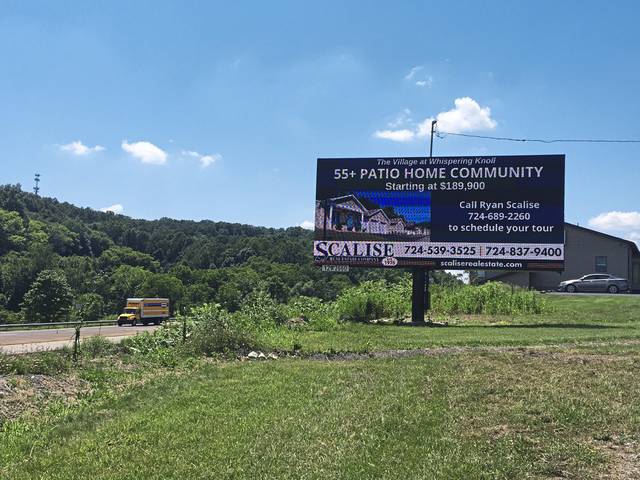
Unity supervisors have approved a zoning amendment meant to assist in conversion of static billboards to electronic versions.
The vote came over a late objection from a man who fears fellow residents in his housing plan along Route 30 would be adversely affected.
Joseph Connelly, who lives off Grayhawk Court, presented the supervisors this week with a petition from 47 neighbors who oppose the township’s relaxation of billboard zoning requirements.
He said residents in the development already have complaints about light being reflected toward the rear of their homes from two existing electronic billboards and are concerned four other static billboards could undergo electronic conversion along a quarter-mile section of Route 30, from Grayhawk Court stretching east toward the Charter Oak community.
“They should not be converted to digital billboards,” Connelly said. “We don’t feel there should be any more.”
Township Solicitor Gary Falatovich said no residents expressed objections to the proposed zoning amendment at two previous public hearings. He added that it also had been endorsed by the planning commission.
“The record on the matter is now essentially closed,” he said of testimony regarding the amendment. He noted the township can’t make an exception to the zoning rules for one particular property.
Connelly said he’d not seen notices for the hearings.
Falatovich pointed out that the zoning change concerns only electronic conversion of existing billboards, not installation of new billboards.
There must be at least 500 feet between electronic billboards on the same side of the road, reduced from the previous 1,000 feet, but converted billboards must stay within their original dimensions.
Falatovich said the amendment eases the township standard on how frequently the message on a billboard can change — from a 30-second interval to 15 seconds.
But, he said, “There can be no flashing, no oscillation. Essentially, it will be like a TV screen.”
The amended ordinance incorporates PennDOT language for regulating the brightness of the billboards. It requires that billboards have devices to automatically dim them during the course of a day.
Also, they may not direct light into a road’s travel lanes or cause a glare that would impair the vision of passing drivers.
Falatovich said the loosened billboard requirements are meant to encourage owners to update and convert some aging static billboards.
“We have on Route 30 a number of billboards that are falling apart and not in the best of shape,” he said. Noting the higher cost of electronic billboards, he said, “We don’t expect a ton of these things to take place.”
Other zoning changes the supervisors approved designated multi-family dwellings as a permitted use in R-2 and R-3 residential districts while listing aviation sales, services and storage as permitted uses in the institutional airpark district.