Five Western Pennsylvania men were among the more than 1,000 killed in a surprise World War II German attack on an Allied port in Italy that has become known as “The Little Pearl Harbor.”
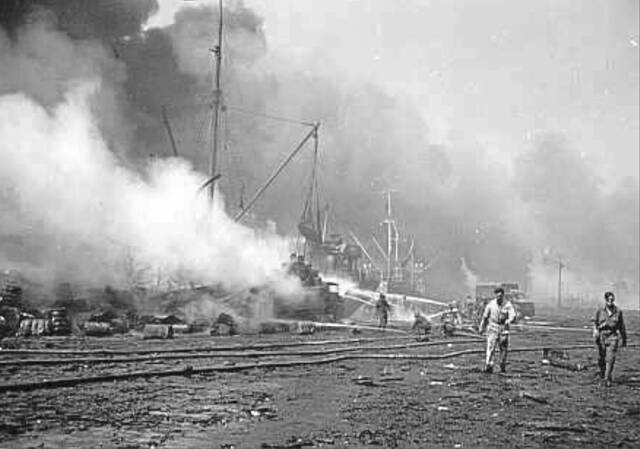
The Dec. 2, 1943, air raid on the Adriatic Sea port of Bari, Italy, came nearly two years and half a world away from the Japanese attack on Pearl Harbor that brought the United States into the war.
Strafing and incendiary bombs caused massive detonations on ammunition ships. Gasoline gushing from a ruptured pipeline and storage facility ignited and engulfed other ships in flames.
All told, 28 ships were destroyed in the evening raid of less than 90 minutes, along with 35,000 tons of cargo, according to research by the nonprofit Stories Behind the Stars. The group is dedicated to honoring all American service members who were lost in World War II, with online posting of their biographies.
Despite the heavy losses and an attempted military cover-up relating to one of the attacked ships, the raid on Bari had a silver lining that led to a breakthrough in cancer treatment.
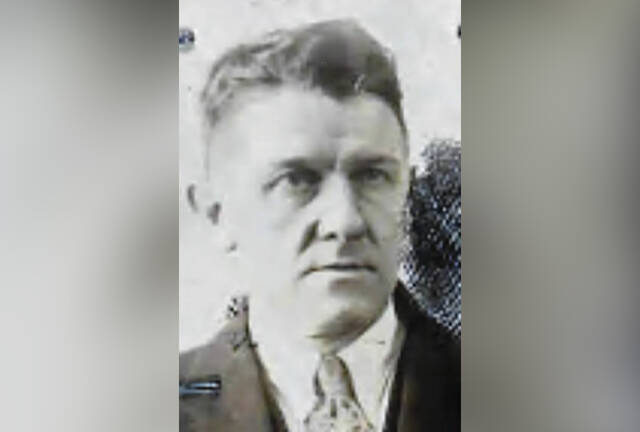
Two Westmoreland County residents who were serving with the Merchant Marines, Utilityman George W.Y. Hutton, 30, of Jeannette and Fireman/Watertender John Mrvan Jr., 25, of Lower Burrell, were killed when the Luftwaffe bombed and strafed the Liberty ship they were assigned to — SS John Harvey.
Pittsburgh native Henry Joseph Krupa, 28, who was a fireman/watertender, and Fred West Brown, 57, a messman and native of McKeesport, were members of the Merchant Marines assigned to the Liberty ship SS Samuel J. Tilden when it was attacked during the Bari raid.
Bombs struck the SS Tilden in her engine room and forward of the bridge, and the vessel’s deck was strafed by German machine gun fire. Friendly anti-aircraft fire from ashore also hit the ship.
To prevent danger to other ships, two British torpedoes sank the SS Tilden.
Of the 41 people aboard the SS Tilden, Krupa, Brown and 25 others were killed. The toll included 10 crew members, 14 U.S. service members and three service members from the United Kingdom.
“The Merchant Marine ships were mostly privately owned cargo ships,” said Kathy Harmon, Pennsylvania state director for Stories Behind the Stars. “During World War II, the government contracted with private companies to operate the ships, controlled the cargo and destinations and put guns and Navy personnel on the ships.
“They delivered troops and war materials into war zones. Men on the fronts depended on this important service for bombs, gasoline, shells, ammunition, food, guns, vehicles, planes, medicine and other materials.
“The seamen were trained by the U.S. Maritime Service to operate the ships and assist in manning the guns. When training ended, the person was ‘released from active duty’ in the Maritime Service and went to sea in the Merchant Marine ships.”
A blast felt miles away
Seaman First Class William George Frohlich, 19, a native of Gibsonia and graduate of Aspinwall High School, was serving as a Navy reservist aboard the Liberty ship SS John L. Motley when it was hit by three bombs during the attack on Bari.
The ship’s cargo of ammunition detonated, causing a blast that shattered windows 7 miles away.
Almost everyone aboard the ship perished, including 36 crew members and 24 Navy Armed Guards — with Frohlich among the latter group.
“The U.S. Navy Armed Guard was a branch of the Navy that was responsible for defending the U.S. and Allied merchant ships from enemy attack during World War II,” Harmon said. “They served as gunners, signal men and radio operators.”
Allied ships shifted to unloading their cargo at Bari, which was in the British Theater of Operations, after the harbor at Naples, Italy, had been attacked in German air raids four times in November 1943.
In a 2023 New England Public Media report, Andrew Lam noted only one anti-aircraft battery was defending Bari, as the Allies thought the Luftwaffe air forces had been depleted. But more than 100 German warplanes took part in the raid.
When the SS John Harvey arrived at Bari, it was carrying mustard gas intended for use in retaliation by the Allies if German forces initiated gas warfare, according to an account of the raid posted on a Naval History and Heritage Command website.
When the ship was attacked, the mustard gas was released, and undetermined amounts of it were held in solution in oil that was floating on the water. Many of those who were aboard the attacked ships and ended up in the water were exposed to the toxic material.
“Of the more than 800 casualties hospitalized after the raid, 628 suffered from mustard gas exposure. Sixty-nine deaths were attributed in whole or in part to this cause,” the Naval History website states. “Those with the energy and will to clean the oil from their own bodies suffered no serious damage, but the remainder suffered varying degrees of mustard burns.
“Eyes began to burn about six hours after exposure and were so badly swollen in 24 hours that many of the patients thought themselves blind. The first deaths occurred without warning 18 hours after exposure.
“About 90% of the gas casualties were American, the bulk of them merchant seamen.”
The cover-up
Stories Behind the Stars notes that an attempted cover-up of the possession of chemical weapons led Allied authorities to attribute the Bari deaths to burns from enemy action. But U.S. and British authorities eventually acknowledged the involvement of the weapons in the incident.
Lam cites the effort of an Army physician, Stewart Alexander, who concluded that the injuries suffered by the Bari raid victims were linked to chemical weapons. That was confirmed when an intact American bomb containing mustard toxin was pulled from the bottom of the harbor.
Stewart also discovered that the mustard gas had harmed patients’ bone marrow, where white blood cells are produced.
That realization eventually was applied in the treatment of leukemia, which involves overproduction of white blood cells. In 1944, a U.S. clinical trial treated cancer patients with a derivative of the chemical used in mustard gas, which led to the first FDA-approved cancer chemotherapy.
Frohlich entered the Navy Reserves at Pittsburgh in October 1942. His voyage to Bari on the SS Motley marked his second crossing of the Atlantic Ocean.
He posthumously received the Purple Heart and was memorialized on the Tablets of the Missing at the Sicily-Rome American Cemetery and Memorial in Nettuno, Italy.
Hutton, who was a farm laborer, enlisted in the Merchant Marines in November 1942. Before their enlistments, Mrvan worked as a watchman at Braeburn Alloy Steel Co. and Krupa was employed as a food truck driver for Robinson Transportation Co.
Before joining the Merchant Marines, Brown had worked as a government ordnance inspector, earlier serving as a clerk in a tube works. He registered for the World War I draft at Greensburg on Sept. 12, 1918, and at one point was living at the Greensburg YMCA. Brown later moved to New York City, his home port.
All four men posthumously received the Mariner’s Medal.
“These Merchant Mariners served in war zones, held rank, wore uniforms, saluted and served under military justice,” Harmon said. “They got paid union wages, could choose the ships they sailed on and could quit when they wanted.
“It wasn’t until 1988 that most Mariners were granted veteran status. Mariners who went to sea after Aug. 15, 1945, serving in wartime in hazardous waters, were given veteran status on Nov. 11, 1998.”
Visit storiesbehindthestars.org to learn more about the nonprofit and its efforts to honor America’s World War II fallen.