Even as Pittsburgh officials laud significant donations that will pay for new ambulances and snowplows, pressure is mounting to buy updated fire trucks, too.
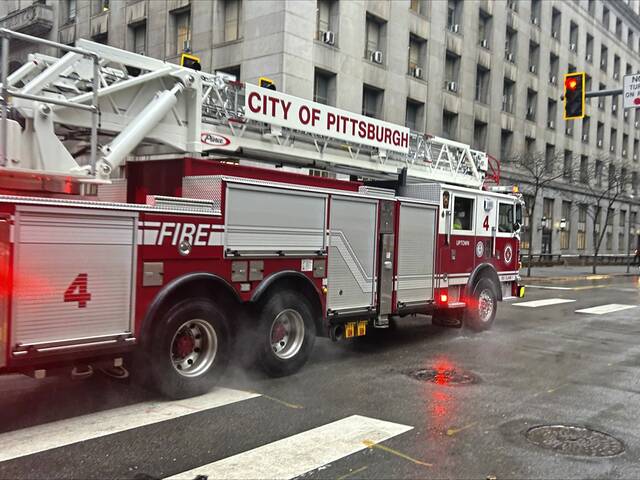
Ralph Sicuro, who leads the union representing city firefighters, on Friday urged the Equipment Leasing Authority board to prioritize fire truck purchases as nearly half the fire fleet is operating beyond its recommended life cycle.
“Inaction today guarantees consequences tomorrow,” Sicuro said, pointing out that the city does not currently have any money budgeted this year for new fire trucks.
Once the city orders a new fire truck, delivery can take up to four years, according to Sicuro.
“That reality makes timing just as important as funding,” he said.
The authority met on Friday to discuss how to prioritize extra funding that has recently materialized.
UPMC has offered up $10 million — divided between this year and next — to buy new ambulances. The PNC Foundation is contributing $2 million to buy new plows, an announcement that was made days after dozens of trucks broke down responding to a massive winter storm.
Plus, City Council doubled the amount the city is putting into the fleet this year when it raised taxes by 20%. Former Mayor Ed Gainey’s budget proposal included about $10 million for the fleet. City Council amended that to $20 million.
A state grant will buy two more ambulances.
In total, the authority has about $27 million to spend on new vehicles this year, “which is far higher than it’s been in previous years,” said Eric Shultz, a budget analyst for the city.
The Equipment Leasing Authority’s budget last year was about $6 million.
Heisler urges investment
Officials for years have been sounding the alarm on the state of the city’s vehicle fleet.
Old vehicles are prone to breakdowns that require costly repairs and keep essential vehicles out of service, an issue officials have struggled to remedy amid financial challenges.
Controller Rachael Heisler — who in November released a report highlighting the need for increased investment in the fleet — told the authority Friday that core services like public works and public safety rely on vehicles.
She urged the authority to invest in new fire trucks now.
“Deferring replacement does not save money,” she said. “It shifts costs to emergency repairs, downtime and operational risks.”
Pittsburgh last year outspent its vehicle maintenance budget by more than $600,000.
50 snow-removal vehicles
Board members seemed to agree that fire trucks ought to be a priority. But the spending plans they analyzed Friday focused on ambulances and snowplows, the specific vehicles that UPMC and PNC, respectively, earmarked their donations to fund.
The plan, Schultz said, is to use the first half of UPMC’s $10 million contribution to buy eight advanced life support, or ALS, ambulances and two basic life support, or BLS, ambulances, plus a heavy-duty rescue truck.
The ALS units have more capacity for advanced care than the BLS vehicles, Public Safety Director Sheldon Williams said. They’re pricier and take longer to be delivered.
Fleet Manager Firmin Maurice said the ALS units should be available by December 2027. The BLS vehicles are expected to arrive this summer.
Officials plan to shift money the city had initially earmarked for ambulances to buy snowplows instead, since UPMC is purchasing the EMS vehicles.
Between that money and the $2 million the PNC Foundation is chipping in, officials will buy about 50 new vehicles to remove snow — though they’re still pricing out exactly what the breakdown of vehicle types will look like.
That will still leave the leasing authority about $10 million that can go to other vehicle purchases, Schultz said.
Sharon Werner, who serves as the city’s chief operating officer and the authority’s board chair, said the board may convene another extra meeting before its regularly scheduled April session to hammer out those details.
“We don’t want to lose even a month,” she said.
Fire priority
Councilman Anthony Coghill, D-Beechview, who sits on the board, said there is “no higher priority than fire.” He pledged to support calls for additional fire trucks.
“It’s kind of a triage system,” said Peter McDevitt, a board members who also serves as council’s budget director. “Everything needs investment.”
McDevitt is set to resign from the board as he leaves his post as council budget director later this month to take on a new role as deputy controller.
He echoed sentiments that the authority needs to prioritize fire trucks because of the expected delivery delays. Now, when the authority has more money than it has in recent years, is the time to make such investments, he said.
“This is the best I’ve ever seen in funding for the ELA to purchase vehicles,” McDevitt said.