
https://triblive.com/local/what3words-app-gains-local-popularity-as-large-events-come-through-pittsburgh/
What3words app gains local popularity as large events come through Pittsburgh

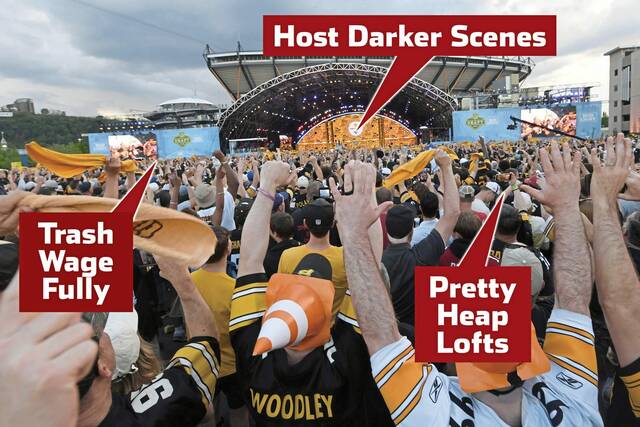
Just three words can be the difference between someone being completely lost — or knowing exactly where they are, at any point in the world.
What3words is an app that uses a geocoding system to divide the world into 3-meter (10-foot) squares and assigns each a unique, three-word address. It’s gaining popularity in the Pittsburgh area and worldwide.
The app can provide precise locations for first responder operations, navigation purposes and even delivery services.
Months before the NFL Draft took over the Pittsburgh region, public safety departments at the city and county level were preparing for a three-day event with total attendance of more than 800,000.
That preparation included an announcement urging visitors to download the What3words app.
The system was co-founded in 2013 by three Britons — Chris Sheldrick, Mohan Ganesalingam and Jack Waley-Cohen.
Sheldrick, who worked in the music industry, organized live events around the world.
“He was essentially using GPS coordinates to tell people where to put this equipment or where the band needed to go, because a traditional address just wasn’t enough,” said Jane Stephenson, chief marketing officer at What3words.
After struggling with poor addressing for years — and a particularly bad day resulting in band equipment being sent an hour north of Rome rather than an hour south — Sheldrick decided to partner with his friend and mathematician, Ganesalingam, to create a system that can identify exact locations in a different way.
The words do not create phrases that a human would use to identify their location. Each word, used in conjunction with the other two, are converted into GPS coordinates that pinpoints the spot.
Ganesalingam created the first three-word address algorithm on the back of an envelope. Sheldrick and Ganesalingam then connected with Waley-Cohen, a school friend with a background in translation, and what3words was born.
“(Their thought process) was like, ‘there must be a simpler way to do this,’ ” Stephenson said.
The men wanted a GPS system based in words rather than numbers.
“GPS coordinates aren’t really designed for humans,” Stephenson said. “They’re for a computer system.”
A widespread system
The London-based system is used by emergency services in every state in the U.S. except Delaware.
The system operates in more than 60 languages, has individual users worldwide and has grown significantly with corporate and business partnerships in the United Kingdom, Mongolia, Vietnam, Germany and Canada in the past 13 years, Stephenson said.
More than 85% of the UK’s emergency service departments utilize What3words.
The algorithm randomizes three-word combinations from a selection of about 40,000 words, Stephenson said. A separate, and even longer algorithm, is used to designate those combos to their respective squares.
“We filtered them, so they’re the best words, the most easily spoken, no proper nouns,” Stephenson said. “There’s a bit of logic built in. The simpler combinations, the sort of shorter words, are in places that they’re more likely to be used. More populated spaces.”
According to Kasey Reigner, public information officer for Allegheny County Department of Emergency Services , the location system was implemented at the county level about five years ago.
“All 911 personnel have been trained on this several years ago, and a e-mail was sent out last week to refresh since the (NFL Draft) may not have definitive locations and visitors not familiar with the area,” Reigner said.
All police, fire and EMS personnel were provided information and training material when What3words was first implemented, she said.
“What3words is extensively used here via the Rapid SOS portal,” Reigner said. “When a caller dials 911 from a wireless line, the W3W is populated in the information box in Rapid SOS for call-takers.”
The Rapid SOS portal is a browser tool used by emergency communication centers, according to its website. It provides real-time, precise location, medical history and telematics to emergency communication centers, helping to reduce response times and increase situational awareness during emergencies.
“If they don’t have a definitive location on the call, they can log those words in the (computer-aided dispatch system) for first responders,” Reigner said in an email. “Those three words change as the caller moves about, thus the call-taker will have to update the (computer-aided dispatch system) as that occurs.”
A parkgoer, for example, might not know their exact location in a larger park, Reigner said. In fact, she said, emergency responders have used What3words to save at least five callers who were injured in county parks.
Joel Croce was sitting in Mellon Park in Pittsburgh’s Shadyside neighborhood recently when he learned about the What3words app.
“I think this is a great idea,” he said. “I think there’s many, many locations like parks that are large, and this can tell first responders exactly where to go.”
Croce said the fact first responders won’t have to rely on vague locators or landmarks to find people who might not know where they’re calling for help from, could be a game changer. Now that he knows about the locator system, Croce said, he’s happy to have another resource in case of an emergency.
While What3words can come in handy in some situations, it might not be as effective in more rural areas, according to Cassandra Kovatch, public information officer for the Westmoreland County Department of Public Safety.
“From what I know about it, in an area in the city where cell coverage isn’t an issue and you have visitors coming in, I can see a use there,” Kovatch said. “If you’re in a county that’s more rural and cell service isn’t as widespread, first responders would still need that cell service to find what location those three words are attached to.”
Westmoreland’s public safety department uses the same Rapid SOS system as Allegheny County’s. The system provides the caller’s location to dispatchers when they use a cellphone, Kovatch said. Dispatchers radio first responders with the location. If a caller reaches out on a landline, an exact address is automatically sent through the system.
“We already get those locations,” Kovatch said. “We haven’t dove too deep with (What3words).”
She said What3words would add an extra step into the process, as dispatchers would relay the three words to first responders who would then have to type those words into the app to activate that navigation system.
“We get that information on dispatch, and we relay it via radio,” she said. “No personal device is needed. (Rapid SOS is) not something the first responders need on their phone.”
In addition to public safety
What3words also is marketed as a general navigation system for everyday use. Stephenson said the three-word code comes in handy when people are heading to a specific overlook at a national park, a remote Airbnb, a specific parking area or other places that might not have exact addresses associated with them.
“We are in different navigation systems — Land Rover, Jaguar, Subaru. Places like that use our system so you can just give the three words to the car and navigate there,” Stephenson said.
Other automotive company partnerships include Lamborghini, Mitsubishi, Iveco trucks and Triumph motorcycles. Companies including Airbnb, Premier In, DK Guides and Lonely Planet also use What3words to help travelers find hotel entrances. The company boasts more than 1,000 corporate and business partners throughout the world.
“We are working to make What3words a global standard for communication locations,” Stephenson said.
Stephenson said despite its reach to navigation uses, What3words’ most powerful use is usually in emergency situations.
“I would say that’s sort of the use case people remember most just because it really can be the difference between life and death when you’re trying to describe your location on a trail or the side of a highway,” Stephenson said. “Those minutes really matter.”
Copyright ©2026— Trib Total Media, LLC (TribLIVE.com)