
https://triblive.com/local/work-underway-to-make-pittsburghs-golden-triangle-shine-under-lights-of-nfl-draft/
Work underway to make Pittsburgh’s Golden Triangle shine under lights of NFL draft

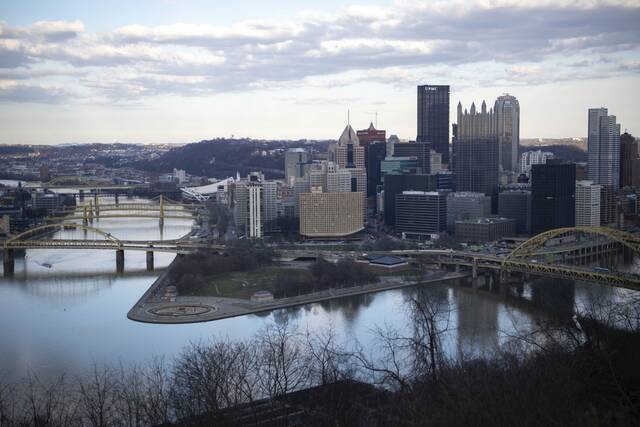
Downtown Pittsburgh is undergoing a facelift before the 2026 NFL Draft shines a massive spotlight on the city in April.
Efforts include modernizing Market Square, opening pop-up retail options, filling empty storefronts with art installations and fixing cracked sidewalks, Pittsburgh Downtown Partnership President Jeremy Waldrup said in a virtual quarterly update Tuesday.
The goal, Waldrup said, is to make Pittsburgh look its best for the massive event coming April 23-25 — and to foster long-term investments in the Golden Triangle.
“This is truly a moment,” Waldrup said. “The draft will drive the local economy.”
Officials predict more than half a million people could flock to the city for the three-day event, which will reach another 55 million television viewers worldwide. The partnership on Tuesday shared estimates that the draft would generate about $200 million in economic impact for the region.
But Waldrup said he doesn’t want the event to be just a “blip on the radar.” He wants to leverage it to encourage repeat visits to Pittsburgh and as an opportunity to make improvements to Downtown that will benefit locals even after the football fans leave.
A slew of upgrades already are underway. By mid-April, at least 30 now-empty storefronts throughout Downtown will house pop-up retailers, said Cate Irvin, the partnership’s senior director of economic development. Vacant ground-floor spots that are still shuttered will be spruced up with art installations.
Lighting improvements at McMasters Way near Market Square and in the 800 and 900 blocks of Liberty Avenue are set to be completed before the draft, too, said Aaron Sukenik, vice president of district development for the partnership.
A pedestrian wayfinding system — a network of signs that help people navigate to various attractions — already is installed. Efforts to repair damaged sidewalks are ongoing, Sukenik said.
Pennsylvania’s Department of Conservation and Natural Resources in December announced that a $3.4 million upgrade of Point State Park — which included improvements to the fountain, better lighting and walkway repairs throughout the 36-acre park — was completed ahead of schedule.
Partnership officials on Tuesday said the new outdoor civic space known as Arts Landing and the Market Square modernization projects are on track to be done in time for the draft, too.
The improvements won’t just look good for the draft, said Sukenik. The partnership plans to host events in Market Square — ranging from large affairs like Picklesburgh and Light Up Night to smaller weekday markets — about 250 days a year. Arts Landing will host the city’s annual arts festival and include Downtown’s only playground.
Officials also highlighted broader efforts to reinvigorate Downtown beyond this spring.
A $600 million revitalization plan backed by Gov. Josh Shapiro is underway. It aims to repurpose empty office spaces as mixed-income housing and breathe new life into an area that has seen office property values decline as remote work took hold with the covid-19 pandemic.
Adding to those efforts, Sukenik said, is a facelift for the Smithfield Street corridor between Sixth and Forbes avenues. That project will include wider sidewalks, trees, in-ground planters and improved lighting. Work is expected to start by the end of the year, Sukenik said. In the meantime, renderings of what the corridor will look like will be pasted to empty windows along that stretch during the draft.
Pittsburgh officials also are pitching in on efforts to attract and retain businesses and ensure Downtown is clean and inviting, said Steve Wray, director of economic development for the city. Mayor Corey O’Connor, on his first full day in office last month, led a walking tour through Downtown, pointing to areas where graffiti needed to be removed, sidewalks repaired or damaged signs torn down.
“Downtown is the heart of our city and will be the centerpiece of our next chapter,” Wray said, outlining a broad vision of attracting innovative businesses, flexible work environments and satellite offices to help bring workers back to the area.
Wray said creating “live, work, play opportunities” Downtown could help encourage recent college graduates or young professionals to stay in the city, a key element of O’Connor’s pitch to grow Pittsburgh.
Mary McKinney Flaherty, the city’s deputy director of economic development, acknowledged Downtown has long been Pittsburgh’s business core. But she wants to revitalize it as a neighborhood with “a really magnetic environment,” the kind of place that draws people in not just for weekday office visits, but also on evenings and weekends.
Though officials are looking to reinvent Downtown as more of a neighborhood, Sukenik said he’s still bullish on people also returning to Downtown offices — though not to the extent that they did pre-pandemic.
“We are still trying to find what the new normal is,” he said.
Copyright ©2026— Trib Total Media, LLC (TribLIVE.com)