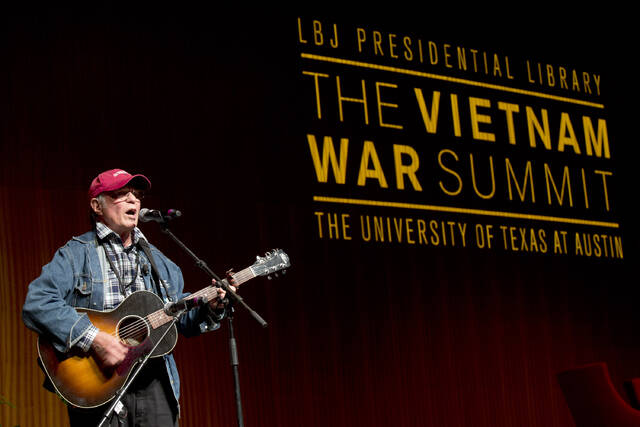
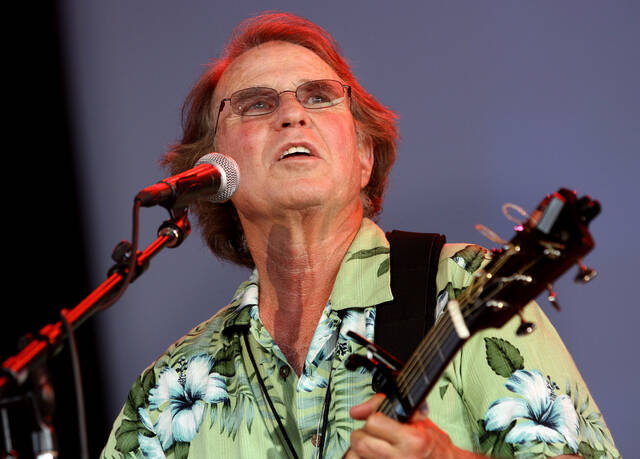

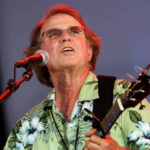
Country Joe McDonald, whose performance at Woodstock — in which he led a crowd of 400,000 through a subversive cheer before starting his satirical anti-war song “I-Feel-Like-I’m-Fixin’-to-Die Rag” — struck a chord so deep, it often obscured the variety and scope of his career, died on Saturday. He was 84.
The cause was complications from Parkinson’s disease, the band announced on social media. Their statement did not provide further details.
In his breakthrough years, McDonald led Country Joe and the Fish, one of the first and most adventurous bands to rise from the Bay Area psychedelic rock scene of the 1960s. After the band’s main run ended in 1970, he released scores of solo albums in a number of styles over many decades.
Yet, it was his showcase at Woodstock, immortalized by its film and soundtrack, in which he spiked the main refrain of his band’s piece “The Fish Cheer,” with a far more provocative F-word, before beginning his best-known anti-Vietnam War song, that came to define him for many.
“From the moment I yelled ‘Give us an F … ’ it became a folk-protest moment,” McDonald told the British newspaper The Independent in 2002. “There was a certain in-yer-face Kurt Cobain-ness about it that matched the attitude of the time pretty well.”
Likewise, McDonald’s albums with the Fish, for which he wrote and sang most of the material, perfectly mirrored the experimentalism and politics of the psychedelic scene that birthed them.
At the same time, the group’s work augmented the era’s usual guitar distortions and drug references with arcane melodies, left-field lyrics and influences that also drew from ragtime, old time folk and the avant-garde.
The Fish’s first single, “Not So Sweet Martha Lorraine,” centered on a death-obsessed woman who also had a yen for homicide, while another early song, “Superbird,” imagined President Lyndon B. Johnson as a lunatic cartoon character.
The tone of the politics and social commentary in McDonald’s songs could range from whimsical to snarky. In “The Harlem Song” he satirized white people’s fetish for Black culture, while in “Fixin’-to-Die,” he sang in the voice of a TV pitchman selling parents on the chance to “be the first one on your block to have your boy come home in a box!” The song culminated in the ironic refrain, “Whoopee! We’re all gonna die!”
While two of McDonald’s albums with the Fish broke Billboard’s Top 40, the band never came close to achieving the success enjoyed by other acts from the San Francisco scene like Jefferson Airplane or the Grateful Dead.
And none of McDonald’s solo works made Billboard’s album chart. Yet, he remained true to his musical instincts and lyrical themes. Long after the Vietnam War ended, he continued to write about its effects and legacy, captured best in his 1986 album “Vietnam Experience,” which features 12 of his songs on the subject.
Joseph Allen McDonald was born on Jan. 1, 1942, in Washington to Worden McDonald, who worked for the phone company, and Florence Plotnik, a political activist. His parents were members of the Communist Party, and they named him after Josef Stalin.
When he was a child, the family moved to El Monte, California, near Los Angeles. “My family were the only communists in the entire area, and we lived a very isolated life,” McDonald told Let It Rock magazine in 1974. “My parents never went dancing or drinking — typical communists.”
At the same time, his father had a Hawaiian guitar that he taught Joe to play when he was 7. When Joe was a teenager in the 1950s, his father was called before the House Un-American Activities Committee, whose aim was to root out communists in the United States, and as a result he lost his job. (His parents later renounced the cause.) At 17, McDonald enlisted in the Navy because, as he told Let It Rock, he wanted to “see the world and have sex.”
After serving a little over three years, he tried college for a few semesters before dropping out to move to Berkeley around the time of the Free Speech Movement. “I went to San Francisco to become a beatnik,” he told Let It Rock.
McDonald started a small underground magazine called Rag Baby before forming an early version of Country Joe and the Fish with guitarist Barry Melton in 1965. His stage name wryly reflected the fact that Stalin was sometimes referred to as “Country Joe” because of his rural background. The word “Fish” was taken from Mao Zedong, who wrote that revolutionaries “must move amongst the people as a fish swims in the sea.”
In a “talking” version of the magazine, the band included the first version of “Fixin’-to-Die,” performed acoustically. “I was inspired to write a folk song — about how soldiers have no choice in the matter but to follow orders — but with the irreverence of rock ‘n’ roll,” McDonald told The New York Times in 2017.
The group later electrified its sound, moved to San Francisco and was signed by Vanguard Records, which released its debut album, “Electric Music for the Mind and Body,” in 1967. The album’s producer, Samuel Charters (best known as a blues historian), refused to let it include “Fixin’” or “The Fish Cheer” on the debut, fearing it would lead to a boycott by radio stations.
But because no one complained about the anti-Johnson song “Superbird,” which was included on the debut, they were allowed to include it on their second album — as its title track no less.
At a show in Central Park in 1968, the band’s drummer, Gary Hirsh, suggested they change the word “fish” to the epithet to make a free speech statement. While the crowd deliriously cheered the change, Ed Sullivan immediately canceled the group’s scheduled appearance on his popular Sunday night variety show.
After performing the augmented “Cheer” in Worcester, Massachusetts, McDonald was charged with inciting an audience to lewd behavior, resulting in a $500 fine and lots of publicity. By the time he performed the provocative version of the song at Woodstock, listeners were primed for it.
At the festival, McDonald played two sets, one with the band and the other solo, a reflection of long-simmering internal tensions that brought the group to an end by the next year. By then McDonald had begun recording solo, having released a set under his own name in late 1969 titled “Thinking of Woody Guthrie,” which consisted entirely of songs associated with that folk legend.
While his solo work tended to be less quirky than his recordings with the Fish, his lyrics remained as imaginative: His 1973 album “Paris Sessions” explored feminism, and “War War War” used original lyrics based on the work of Canadian poet Robert William Service). In 2017, he celebrated half a century of his career with an album titled “50.”
McDonald had a son and a daughter, Ryan and Emily, with his fourth wife, Kathy Wright; another son and daughter, Devin and Tara, with his third wife, Janice Taylor; and a daughter, Seven Anne McDonald, with his second wife, Robin Menken. Complete information on his survivors was not immediately available.
Throughout his career, McDonald’s politics and lyrical concerns avoided the literal or the doctrinaire, extending the tone of his most famous song.
Speaking of the effect of “Fixin’ to Die” to Let it Rock, he said: “You laugh at the war. You laugh at yourself, and you laugh at the left wing at the same time. Something’s very attractive about the song.”
“Something’s very attractive about drugs, too,” he added. “It’s basically an insane song.”