
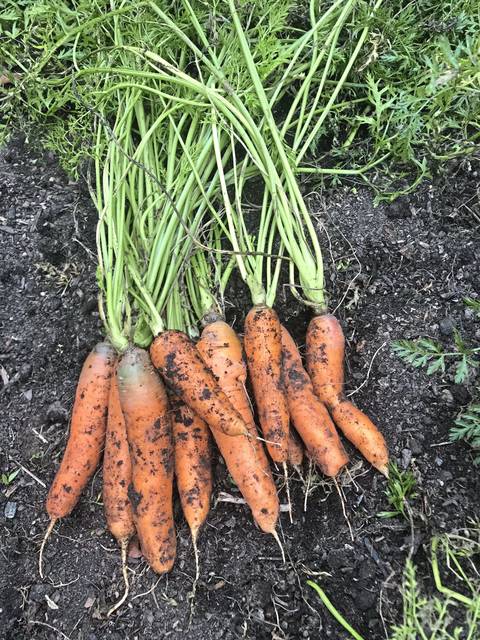
My recent column on carrots brought these letters. And they piqued my curiosity to get more information:
Q: I just finished a column by you about carrots in the Fredericksburg Virginia Free Lance Star. I always wondered about baby carrots. Now that you have confirmed that they are cut regular carrots, I am wondering how the cut and packaging with a fair bit of moisture impacts the nutritional value. Also, do carrots lose nutritional value over time? Thank you.
Dr. L. DeLacy
Q. I enjoyed your column about carrots. But I must disagree with you on the topic of baby carrots being regular carrots cut to small sizes. If you cut one of the baby carrots in half or bite into it, you will find a very small core inside, which indicates to me that it is not a larger carrot cut into a smaller size. At least that is what I have discovered in the carrots here in central Idaho where I live. Sincerely, D. Johnson
Here’s where the confusion lies: There are really two kinds of baby carrots. True baby carrots are those that are harvested early before they reach full maturity. Or they may be a certain breed of miniature carrot. These baby carrots are around 3 to 4 inches long, say growers.
The most common baby carrots that we roll out for vegetable trays and pack in lunches are really baby cut carrots. That is, they are regular size carrots that have been peeled and cut into approximately 2-inch lengths. (I was able to observe this process in a California vegetable plant a few years back.)
Besides being a great way to get kiddos to eat more veggies, growers say this process results in less waste of the carrot since smaller pieces can still be used. Interesting too, that the diameter of these carrots has been made smaller by planting them closer together in the field than traditional carrots.
Nutritionally, baby carrots are similar in nutrients to their larger counterparts. Yet, like other produce, they lose some nutrients and protective phytochemical when they are peeled. There is still plenty of nutritional value in a peeled carrot, however.
Baby carrots are also prone to dry out without their protective “skin.” That’s why they are packaged in bags that help retain moisture. I mentioned in my previous column that one sign of a dehydrated carrot is the white “blush” that forms on its surface.
All produce, including carrots, will lose its nutritional value over time. Store your baby carrots in the fridge, keep them moist and use by the “Use by” date on the package. Thanks for writing.