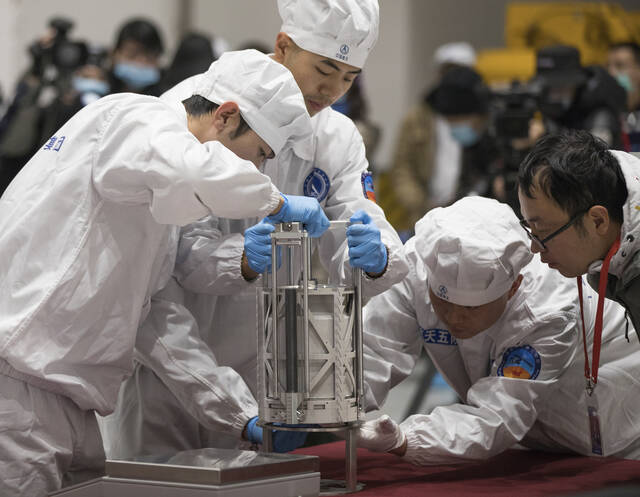
CAPE CANAVERAL, Fla. — Scientists have discovered a new and renewable source of water on the moon for future explorers in lunar samples from a Chinese mission.
Water was embedded in tiny glass beads in the lunar dirt where meteorite impacts occur. These shiny, multicolored glass beads were in samples returned from the moon by China in 2020.
The beads range in size from the width of one hair to several hairs; the water content was just a miniscule fraction of that, said Hejiu Hui of Nanjing University, who took part in the study.
Since there are billions if not trillions of these impact beads, that could amount to substantial amounts of water, but mining it would be tough, according to the team.
“Yes, it will require lots and lots of glass beads,” Hui said in an email. “On the other hand, there are lots and lots of beads on the moon.”
These beads could continually yield water thanks to the constant bombardment by hydrogen in the solar wind. The findings, published Monday in the journal Nature Geoscience, are based on 32 glass beads randomly selected from lunar dirt returned from the Chang’e 5 moon mission.
More samples will be studied, Hui said.
These impact beads are everywhere, the result of the cooling of melted material ejected by incoming space rocks. Water could be extracted by heating the beads, possibly by future robotic missions. More studies are needed to determine whether this would be feasible and, if so, whether the water would be safe to drink.
This shows “water can be recharged on the moon’s surface … a new water reservoir on the moon,” Hui said.
Previous studies found water in glass beads formed by lunar volcanic activity, based on samples returned by the Apollo moonwalkers more than a half-century ago. These, too, could provide water not only for use by future crews, but for rocket fuel.
NASA aims to put astronauts back on the lunar surface by the end of 2025. They’ll aim for the south pole where permanently shadowed craters are believed to be packed with frozen water.