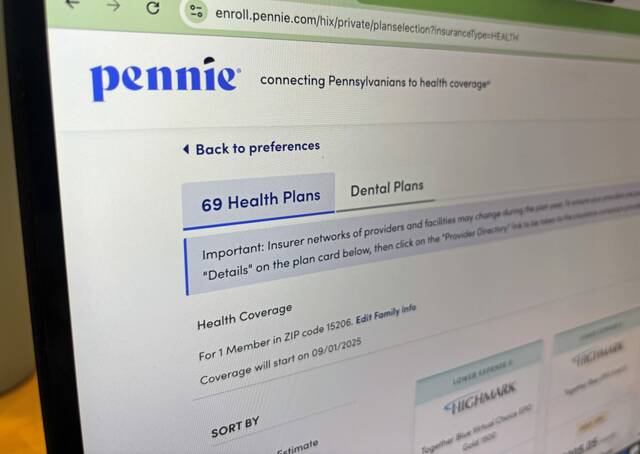
For every new enrollment, two Pennsylvanians are dropping Obamacare coverage as steep government subsidies are set to expire at year’s end.
About 38,000 people who have Affordable Care Act coverage through Pennie, the state’s health insurance exchange, have opted not to renew their plans for next year. That’s compared to 19,000 new enrollees.
“We are seeing how much this affordability matters to people,” Pennie Executive Director Devon Trolley told TribLive on Tuesday.
Open enrollment runs from Nov. 1 to Jan. 15, so there’s still time for an enrollment surge. But Trolley said she’s certain Pennie’s headcount will shrink if an enhanced version of Obamacare subsidies sunsets.
Prior to open enrollment, Pennie projected 450,000 of its 500,000 users would face higher premiums without the subsidies, with 150,000 of them leaving the exchange as a result. Many more might choose plans that are cheaper but offer lesser coverage.
Financial aid for Obamacare served as the focal point of the recent government shutdown. Senate Democrats failed to get the enhanced subsidies extended as part of the agreement to reopen the government, but they were promised a December vote on the matter.
The Senate is expected to vote Thursday on a Democratic proposal to prolong the existing assistance for three years, but it’s unlikely to garner enough votes.
Republicans, who control both chambers of Congress, have struggled to unify behind an alternative. Party leadership is caught between centrists seeking a compromise bill and conservatives hoping to see the deeper discounts lapse.
Rep. Brian Fitzpatrick, R-Bucks County, has been a leading voice for extending the enhanced subsidies — with conditions. He introduced a bill Tuesday that would largely keep support at its current level through 2027 but require fully subsidized enrollees to make a minimum contribution.
Fitzpatrick’s office did not immediately return a request for comment.
The offices of Sens. John Fetterman, D-Braddock, and Dave McCormick, R-Pittsburgh, also did not return requests for comment right away.
For now, Pennie and its users have to assume the stronger subsidies, introduced in 2021 as a pandemic relief measure, are going away.
That means smaller discounts for people making under four times the federal poverty level — about $62,000 for a single adult — and the end of a cost cap for everyone else that limits premiums to 8.5% of their earnings.
Subsidies in the original 2010 Affordable Care Act will remain in place.
‘Nightmare scenario’
The top age group dropping coverage so far is 55 to 64. Trolley suspects that’s because about two-thirds of them exceed the income threshold and will no longer be eligible for a subsidy of any size.
People between 25 and 34 are the second-largest group. That’s a problem, because younger, healthier people are crucial to offsetting the cost of care for older, sicker patients.
“If all that’s left is people who are sick because they can’t afford to not have insurance … that’s the real nightmare scenario,” said Jonathan Greer, president and CEO of the Insurance Federation of Pennsylvania. His organization represents UPMC, Highmark and other insurance companies that offer plans on Pennie.
“Even relatively low dollar amounts can make a difference in whether those folks can stay enrolled or not,” Trolley said.
A large chunk of Pennie’s nearly 500,000 enrollees have yet to make a decision. That’s not unusual. Enrollment picks up by four to five times in December compared to November, according to Trolley.
But some people might be sitting on the sidelines this year because of the fluid political situation. Now would be the time to jump in, according to Trolley.
Anyone who enrolls after Dec. 15 could risk not having coverage in time for the start of next year. Enrollees can change their selection any time before Jan. 15.
If Congress does act, Pennie faces the challenge of updating its system accordingly. A brief enrollment blackout may be necessary, Trolley said.
Regardless of what happens in Washington, D.C., the enrollment process has been warped in ways that can’t be fixed right away.
“We absolutely would not be able to get back 100% of people who walked away or get 100% of people to reevaluate their coverage options,” Trolley said.
Few alternatives
It’s not yet clear where folks who dropped their Pennie coverage are headed.
Some might accept an employer-sponsored plan they had previously declined in favor of Obamacare coverage. But many people use Pennie because they are self-employed or their employer doesn’t offer health benefits.
Patrick Keenan, director of policy and partnerships at the Pennsylvania Health Access Network, warned there’s not an affordable, adequate alternative for many people.
“A lot of the other kinds of plans that are out there leave people on the hook for very basic, routine, normal kinds of health care,” he said. “They’re kind of like Swiss cheese plans.”
Other people who strike out on Pennie might simply choose to go without insurance. Uninsured individuals often wait to seek treatment until their condition reaches emergency levels and struggle to pay back the cost of resulting care, he noted.
“It really is a disaster for both patients and the communities they’re in, and certainly health care providers,” Keenan said.