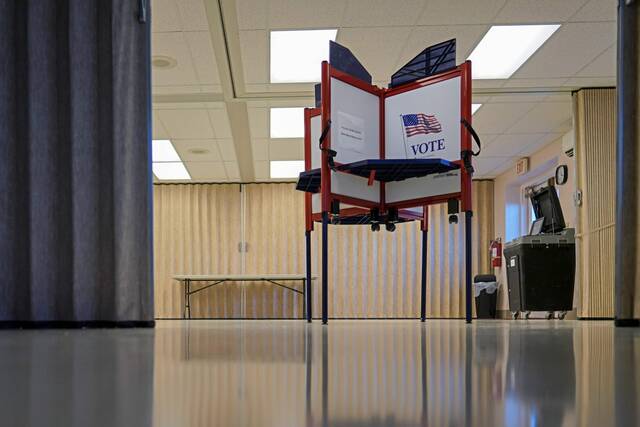
HARRISBURG — The 2024 presidential election is two months away and, in Pennsylvania, Republicans continue to shrink the margin by which Democrats lead in registered voters.
Democrats had 350,341 more registered voters compared to Republicans as of Monday, according to this week’s data update from the Department of State.
That lead narrowed from 395,699 entering the primary election on April 23 and is another indicator of just how tightly contested the presidential election is expected to be.
“Anytime you see registration trends breaking in your direction you can’t ignore the positive nature of those shifts. What they signify is always a little less clear in terms of impact. Registration does often lag voting behavior,” Chris Borick, political science professor and director of the Muhlenberg College Institute of Public Opinion, said.
President Joe Biden edged former President Donald Trump by 80,555 votes in 2020, while Trump took the commonwealth himself in 2016 by 44,292 votes over Hillary Clinton.
Republicans had a 6-to-2 advantage over Democrats in new registrations following the spring primary this year, the data show.
The party’s momentum slowed to 3-to-2, however, when the window is narrowed to the date when Biden dropped out of the race on July 20 and was replaced by the eventual Democratic nominee, Vice President Kamala Harris.
Per the Harris-Walz campaign, the Democrats now have 50 field offices spread across Pennsylvania including 16 in rural counties that Trump won by double-digits in 2020.
“Maybe it’s not going to bring over a lot of Republican voters. I have to wonder if it doesn’t help energize whatever Democratic voters (they) have in those areas,” Daniel Mallinson, associate professor of public policy and administration at Penn State-Harrisburg, said. “Is it enough to swing the election? I don’t know. They’re going to need every voter they can get to turn out.”
There were 8,867,062 total registered voters in Pennsylvania as of Monday — 3,913,553 Democrats, 3,563,212 Republicans, 1,045,048 non-party affiliates and 345,249 third-party members.
Trends in partisan registration are cyclical. Democrats led Republicans by 442,671 entering the 1998 fall election, the oldest registration data available online from the Department of State. Democrats continued to make gains before seeing their lead swell to more than 1.2 million voters ahead of the 2008 election when former President Barack Obama won his first of two terms.
The following year, a reversal began and ever since Republicans have consistently made gains. Still, in that time, Democrats largely dominated statewide elections, as noted by Berwood Yost, director of the Center for Opinion Research at Franklin & Marshall College.
“I think what we’re seeing play out is that party registration is catching up with how voters have been reorganizing themselves, particularly since 2016. The defining feature of the state’s partisan reorganization is not so much the narrowing gap between (Republicans and Democrats), but the increase in voters who register in another party,” Yost said.
Third-party registrations represent nearly 16% of the electorate this year so far compared to 10% in 2000, Yost said, adding that “the largest change in voter registration since 2020 is among those who are registered independent.”
A combined 55,149 Democrats and Republicans left the respective parties to become independent voters in Pennsylvania so far in 2024. That’s compared to 44,247 Democrats who switched to the Republican Party and 17,252 who left the Republicans to become Democrats.