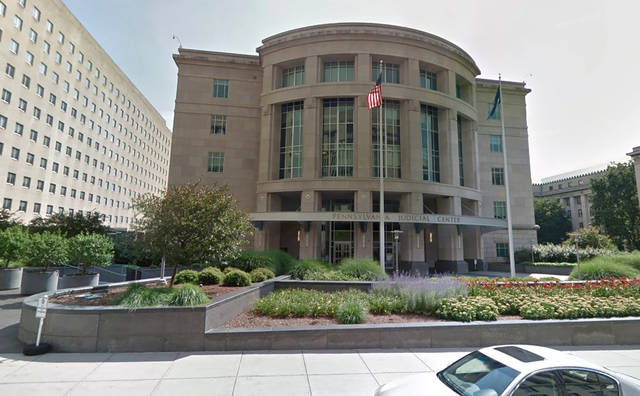
HARRISBURG — Pennsylvania’s Supreme Court has upheld a ban on state-level or federal candidates being nominated by more than one political party for the same office, a rule that helps the two major parties.
The decision Wednesday said state Rep. Chris Rabb was properly prohibited from getting on the ballot in Philadelphia in 2016 under both the Democratic and Working Families party banners.
The court’s four-justice majority said the rule against cross-nominations does not infringe on rights of free speech or free association.
The majority said double nominations would make it more difficult to measure public support for parties and determine whether “political bodies” can obtain status under Pennsylvania law as a political party, and therefore get easier ballot access.
“Because no procedure exists in the Election Code to disaggregate the votes received by Rabb in his capacity as the Democratic Party nominee and as the Working Families Party nominee, the (State) Department would be unable to determine what proportion of the votes cast for Rabb should be allocated when making the five percent calculation to qualify the Working Families Party as a political party in Philadelphia County,” wrote Justice Sallie Mundy, a Republican, for the majority.
Political parties get their candidates onto the fall ballot through primaries, whereas political bodies must collect signatures.
The ban on cross-nominations applies to all Pennsylvania races except those that are specifically exempted under the Election Code, such as county common pleas court judges, magisterial district justices and school directors.
Rabb’s nominating papers to run as the candidate of the Working Families Party were rejected by the state. He won the election as a Democrat and is now in his second term.
Rabb said fusion balloting, as double nominations are known, can reveal more about where candidates are on the political spectrum than simply having the support of major parties.
“Anytime anyone wins, the victor says, this is a clear mandate for whatever,” Rabb said. “You have no proof of that. With fusion balloting, you at least have a closer proxy for where this candidate is.”
The defendants were the state and officials who administer elections. Department of State spokeswoman Wanda Murren declined to comment on the decision.
In a lengthy dissent , Justice David Wecht, a Democrat, said the Election Code’s anti-fusion provisions infringe on the state constitution’s guarantee of free and equal elections.
Wecht said research about anti-fusion legislation across the country has consistently shown the laws are “mechanisms by which dominant parties consolidated their power at the expense of minor parties.”
The state constitution’s guarantee of free and equal elections, Wecht wrote, “is compromised where the regulatory approach adopted by the Legislature has the well-documented effect of reducing voter access to alternative viewpoints, limiting voters’ ability to tangibly support their chosen political party, and depressing voter enthusiasm and participation.”