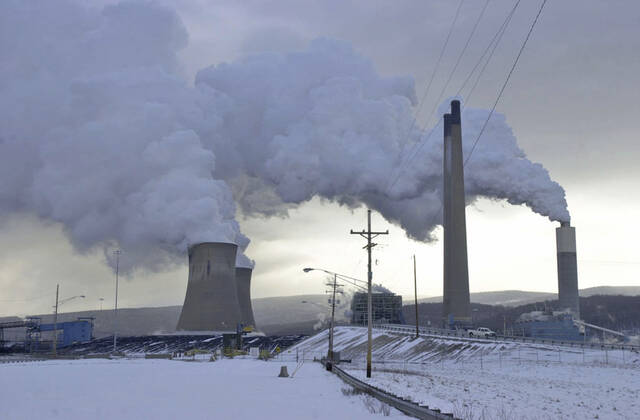
HARRISBURG — Pennsylvania cannot enforce a regulation to make power plant owners pay for their planet-warming greenhouse gas emissions, a state court ruled Wednesday, dealing another setback to the centerpiece of former Gov. Tom Wolf’s plan to fight global warming.
The Commonwealth Court last year temporarily blocked Pennsylvania from becoming the first major fossil fuel-producing state to adopt a carbon-pricing program, and the new ruling makes that decision permanent.
The ruling is a victory for Republican lawmakers and coal-related interests that argued that the carbon-pricing plan amounted to a tax, and therefore would have required legislative approval. Wolf, a Democrat, had sought to get around legislative opposition by unconstitutionally imposing the requirement through a regulation, they said.
The court agreed in a 4-1 decision.
The regulation written by Wolf’s administration had authorized Pennsylvania to join the multistate Regional Greenhouse Gas Initiative, which imposes a price and declining cap on carbon dioxide emissions from power plants.
It would be up to Wolf’s successor, Democratic Gov. Josh Shapiro, to decide whether to appeal the decision to the state Supreme Court. Shapiro’s administration had no comment Wednesday on whether it would appeal, and Shapiro himself hasn’t said publicly whether he would follow through on the plan to join the consortium, should the courts allow it.
Still, Shapiro is “focused on addressing climate change, reducing emissions, and protecting public health while creating jobs and protecting consumers,” Shapiro’s administration said in a statement.
Republican lawmakers hailed the decision and urged Shapiro not to appeal it. Such a plan continues to have no chance of passing the state Legislature, where the Republican-controlled Senate has been protective of hometown coal and natural gas industries in the nation’s No. 2 gas state.
In a statement, Senate Majority Leader Joe Pittman, R-Indiana, said Pennsylvania lawmakers should now work to “foster greater energy independence, while ensuring the responsible development of our God-given natural resources.”
In the House, where Democrats hold a one-seat majority, neither a carbon-pricing plan, nor Shapiro’s most well-defined clean-energy goal — a pledge to ensure that Pennsylvania uses 30% of its electricity from renewable power sources by 2030 — have come up for a vote.
A coalition of environmental advocacy groups said there is no alternative climate plan waiting on Shapiro’s desk and, in a statement, they urged Shapiro to appeal the decision to “demonstrate his commitment to protecting the climate, human health, and the economic future of Pennsylvanians.”
Critics had said the pricing plan would raise electricity bills, hurt in-state energy producers and drive new power generation to other states while doing little to fight climate change.
Opponents also included natural gas-related interests, industrial and commercial power users and labor unions whose members build and maintain pipelines, power plants and refineries.
Backers of the plan had called it the biggest step ever taken in Pennsylvania to fight climate change and said it would have generated hundreds of millions of dollars a year to promote climate-friendly energy sources and cut electricity bills through energy conservation programs.
The plan’s supporters included environmental advocates as well as solar, wind and nuclear power producers.