
https://triblive.com/news/pennsylvania/shapiro-unveiling-53-2b-spending-plan-for-coming-fiscal-year/
Shapiro proposes record $53.3B in spending for coming fiscal year

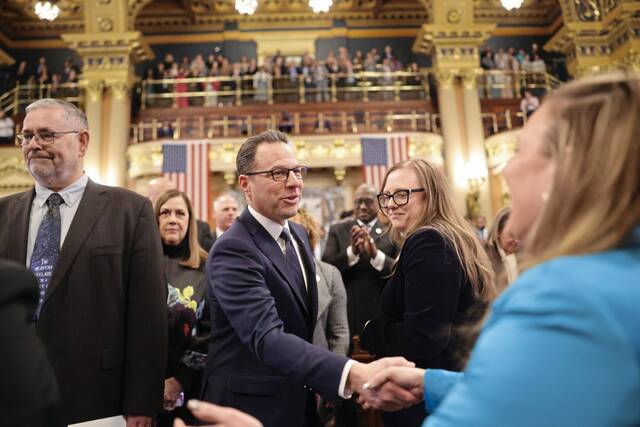
Gov. Josh Shapiro on Tuesday unveiled a proposed $53.3 billion budget for the coming fiscal year that would use nearly $4.6 billion, or more than half, of the state’s largest reserve fund to balance.
Shapiro said in an address to a joint session of the state House and Senate that his budget would continue “historic investments” in education, workforce development, public safety and economic growth.
“The investments we’ve made are paying off,” Shapiro said.
In a news conference following the governor’s address, Republican leaders in the House and Senate panned Shapiro’s proposed budget as fiscally irresponsible.
“The governor simply wants to spend too much money in this budget, period, full stop,” said Senate Majority Leader Joe Pittman, R-Indiana.
Shapiro would use $4.6 billion from the state’s so-called rainy day fund — formally, the Budget Stabilization Reserve Fund — to balance his proposed spending plan, which is 6.3% larger than this year’s budget. The state is projected to end this fiscal year with $7.7 billion in the reserve fund, the state’s Independent Fiscal Office reported late last month.
“We’ve built up surpluses. We need to return some of that money to the commonwealth,” said House Majority Leader Matt Bradford, D-Montgomery County. “This is a balanced budget and this is a budget that Pennsylvania can afford.”
“If they want to cut their way to balanced,” Senate Minority Appropriations Chair Vincent Hughes, D-Philadelphia, said of Republicans, “let’s see what it is they want to cut.”
Shapiro said Pennsylvania is the only state in the Northeast with a growing economy, graduation and school attendance rates are up, violent crime and unemployment are down, and the state is producing more energy than ever before. The governor said private companies have invested more than $39 billion in Pennsylvania during his time in office, creating more than 21,500 jobs.
“What we’re doing, together, is working,” Shapiro said.
But Shapiro said there is room for improvement.
The governor said he wants to find ways to help make life more affordable for Pennsylvanians who are concerned about the high costs of housing, utilities, health care and other everyday expenses.
“Home prices and rents are rising faster than wages. Over half of all homes are more than 50 years old, making them more expensive to repair. And if we don’t take action now, we’ll be short 185,000 homes by 2035,” further driving up costs by increasing demand for housing, Shapiro said.
To address this, Shapiro said he wants to create a $1 billion critical infrastructure fund that, through the issuing of bonds, would support housing construction, improvements and other critical infrastructure needs across the state. To protect renters, Shapiro proposed initiatives including establishing a statewide cap on rental application fees and prohibiting landlords from charging fees before a prospective tenant can view a property.
Senate President Pro Tempore Kim Ward, R-Hempfield, said that if the $1 billion fund is created, bonds for it wouldn’t be issued until 2028 at the earliest. Alluding to widespread speculation that Shapiro could be a candidate for the Democratic presidential nomination that year, Ward said, “He would leave that burden (of bond debt) for all of us. Putting all of that money into a bond, we again will be left holding the bag. That means the people of Pennsylvania will be left holding the bag.”
Shapiro said he also is calling on utility companies to control rising costs. He said he has created a watchdog role within his administration to closely examine all requests by utility companies to raise rates and, if necessary, take legal action to stop exorbitant hikes. He also wants the state Public Utility Commission to more heavily scrutinize spending by utility companies.
“We grant these utilities a monopoly and, in exchange, they have a legal responsibility to keep their costs just and reasonable,” Shapiro said.
As for proposals aimed at generating new revenue for the state, Shapiro is again calling for the legalization of marijuana for recreational use and taxing and regulating video gaming terminals that have become ubiquitous at bars, convenience stores, fraternal clubs and elsewhere.
Shapiro, a Democrat from Montgomery County, has called for such measures in past budget addresses, but the divided Legislature has failed to close deals on those issues. Democrats hold a slim majority in the House, but Republicans control the Senate.
“We’re putting our communities at risk and losing out on billions of dollars in revenue by doing nothing on both,” Shapiro said.
Shapiro’s budget proposed legalizing recreational marijuana by July 1 and beginning sales by Jan. 1, 2027. His office estimated that doing so could generate $729.4 million for the state in the 2026-27 fiscal year, with $659.6 million coming from license fees, $36.9 million coming from an adult use cannabis tax and $32.9 million coming from sales and use taxes on cannabis sales.
Taxing and regulating video game terminals could generate $765.9 million for the state in the 2026-27 fiscal year, with $743.1 million coming from a 52% tax on the machines’ gross revenues, according to Shapiro’s office.
Shapiro also said now is the time, after years of debate, to raise Pennsylvania’s minimum wage of $7.25 an hour. It has been unchanged for 16 years. Shapiro is proposing a rate of $15 an hour.
“In that time, every single one of our neighboring states has raised the wage for their workers,” Shapiro said.
“If you aren’t going to do this because it’s the right thing to do or because it would let more families put food on the table for their kids, then do it because it’s going to save us $300 million and shrink our entitlement budget by growing our workforce and putting more money back in our workers’ pockets,” Shapiro said.
In response to actions by the Trump administration to withhold federal funding to Pennsylvania, Shapiro also proposed the creation of a $100 million fund “to help mitigate any future actions — or inaction — by the federal government that threaten services Pennsylvanians rely on.”
Shapiro said he took the Trump administration to court and won after it threatened to revoke $18 million in homeland security grants to the Philadelphia region last fall. The state faced similar challenges with federal funding addressing issues such as plugging abandoned wells, providing health care for rural communities, improving school infrastructure and providing food benefits through SNAP, he said.
In all, Shapiro said, the state has gone to court 19 times to challenge administration policies that affected federal funding to Pennsylvania.
“Now is a time when we need to stand up together for our commonwealth and be prepared should (the federal government) try to take away more of what is owed to us,” Shapiro said.
Shapiro and lawmakers in the House and Senate said they planned to meet Wednesday to begin jointly discussing the budget.
“We begin budget negotiations tomorrow. June 30 is a real time,” Hughes said, referring to lawmakers’ state-mandated deadline to adopt the 2026-27 budget. Lawmakers have missed that deadline in 14 of the past 22 years, including last year’s 135-day budget impasse.
Copyright ©2026— Trib Total Media, LLC (TribLIVE.com)