
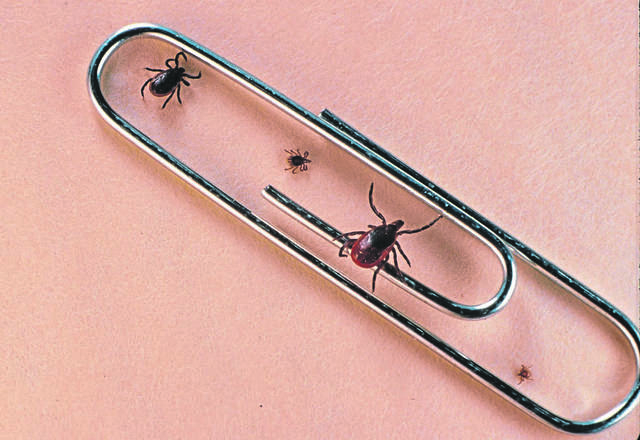
As the weather warms and people once again take to the outdoors, state officials are reminding residents that in addition to health and safety protocols for covid-19, there is also one of the state’s most persistent pests to consider: the black-legged tick, the primary vector for Lyme disease in Pennsylvania.
“As climate change continues to warm our winters, we’re seeing higher tick populations surviving months that used to be too cold to survive,” said Pennsylvania Department of Environmental Protection Director Patrick McConnell. “As the number of ticks continues to rise, so do the odds of tick-borne disease transmission.”
States from Virginia, West Virginia and Pennsylvania all the way up the Eastern Seaboard are categorized as “high incidence” for Lyme disease, according to the Centers for Disease Control. In 2018, Pennsylvania reported more than 7,900 confirmed Lyme cases, the highest in the nation. New Jersey is the second highest, but with only 2,876 confirmed cases it has less than half of Pennsylvania’s Lyme numbers.
Black-legged, or deer ticks, are the most common carriers for both Lyme disease and anaplasmosis, a bacterial infection that can be even more serious than Lyme.
They typically thrive in tall grass, brush and wooded areas, but DEP officials said they have been found in every county in Pennsylvania and can live in nearly any habitat.
“We must remain diligent, both in protecting ourselves from bites, but also in seeking long-term solutions to address climate change,” McConnell said.
Simple ways to reduce your chance of a tick bite are:
• Cover exposed skin with lightweight, light-colored clothing.
• Avoid tick-infested habitats like densely forested areas or tall grass.
• Use an insect repellent containing 20% or more DEET.
• Immediately check yourself, children and pets for ticks upon arriving home.
• Take a shower immediately to remove any ticks.
• If possible, dry your clothing and gear in a dryer to kill any unattached ticks.
Common signs of a tick disease include fever, headache, chills and muscle aches. Lyme often presents with a “bull’s-eye”-style rash, but not always.
Ticks are most likely to infect humans in late spring and summer, but can be active year-round in some areas.
“While we encourage safe recreation, we must be aware of ticks and the serious diseases they carry,” said state Acting Health Secretary Alison Beam.
In addition to the black-legged tick, researchers announced in 2018 that they’d discovered the presence of the Asian long-horned tick in Pennsylvania.
Native to east and central Asia, the tick was originally identified in the United States in New Jersey, where it was found in large numbers of sheep in 2017. Thus far, it is not known to carry any infectious pathogens.