WASHINGTON — The Senate will pursue a spending increase next year of about 3.4% for defense and 2.7% increase for non-defense programs under an agreement reached by top Democratic and Republican lawmakers on the Senate Appropriations Committee, setting up a certain clash with the House, which is pursuing less spending in both categories.
Under an agreement reached last year by President Joe Biden and then-Speaker Kevin McCarthy, spending was set to increase 1% for defense and non-defense programs in fiscal year 2025, bringing the tallies to about $780.4 billion for non-defense and $895.2 billion for defense.
Some senators said the increase would not keep up with inflation and would be tantamount to a cut for many programs.
The bipartisan Senate agreement unveiled this week will provide $13.5 billion more in emergency funding for non-defense programs and $21 billion more for defense programs than the Biden-McCarthy agreement provided.
Meanwhile, House Republicans are pursuing a more austere course, allowing for a 1% increase for defense, but significant cuts for non-defense, coming to a roughly 6% cut on average, though some programs would be cut much more and some GOP priorities not at all.
While some Republican senators were clamoring for more defense spending, Democrats insisted on similar treatment for non-defense programs.
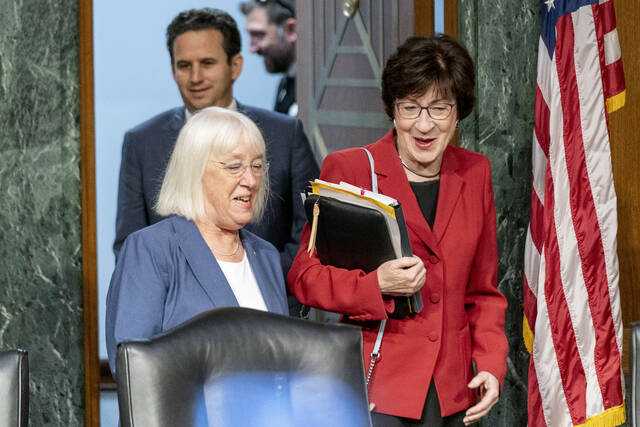
“I have made clear that we cannot fail to address the insufficient funding levels facing us and that I absolutely will not leave pressing nondefense needs behind,” said Sen. Patty Murray, the Democratic chair of the Senate Appropriations Committee.
Murray has been negotiating with Sen. Susan Collins, the ranking Republican on the committee, on discretionary spending for next year. Such spending does not include mandatory spending on major entitlement programs, namely Social Security and Medicare, which represent about two-thirds of annual federal spending and does not require an annual vote by Congress.
Collins said the U.S. is facing one of the most perilous security environments in the last 50 years and that threats from Iran, Russia and China “must be met with the resolve to invest in a stronger national defense.”
“Under this agreement, additional funding for our military would be accompanied by efforts to halt the flow of fentanyl at our borders, invest in biomedical research, and maintain affordable housing programs,” Collins said.
The Republican-led House has been acting more quickly on spending than the Senate. It has passed four of the 12 annual spending bills so far while the Senate has not yet passed any. However, all four House bills have generated veto threats from the White House, drew widespread Democratic opposition and have no chance of passing the Senate in their current form.
That means a protracted, monthslong battle that will likely require one or more stopgap spending bills to keep the federal government fully open when the new fiscal year begins Oct. 1.
With the elections and lawmakers spending so much time away from Washington, Congress is not expected to get the final spending bills over the finish line until after the elections. Final passage could also be pushed off to next year if one party manages to win the White House and both chambers of Congress.
The agreement that leaders of the Senate Appropriations Committee reached on spending comes as the committee was set to take up its first three spending measures on Thursday.