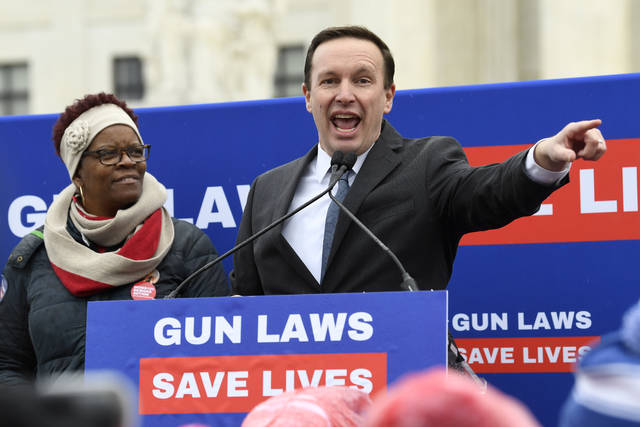


WASHINGTON — A bipartisan deal on a government spending bill would for the first time in two decades provide money for federal research on gun safety. A law adopted in the 1990’s has effectively blocked such research and prohibits federal agencies from engaging in advocacy on gun-related issues.
The spending bill, set for a House vote as soon as Tuesday, would provide $25 million for gun violence research, divided evenly between the National Institutes of Health and the Centers for Disease Control and Prevention.
If approved by the House and Senate and signed by President Donald Trump, the proposed funding would be a major legislative victory for Democrats, gun control supporters and researchers who have pushed in recent years to study gun violence in the same way scientists look at opioid overdoses and other public health crises.
“Nearly seven years to the day after we lost 20 beautiful children and six adults at Sandy Hook Elementary” in Newtown, Conn., “we are finally making progress in Congress to reduce gun violence,” said Rep. Rosa DeLauro, D-Conn., chairwoman of the labor and health subcommittee of the House Appropriations panel.
The new funding for NIH and CDC “will help us better understand the correlation between domestic violence and gun violence, how Americans can more safely store guns and how we can intervene to reduce suicide by firearms,” DeLauro said.
Democratic Sen. Chris Murphy, who represented Newtown in the House when the 2012 shootings occurred, said the agreement shows “the power of the gun violence prevention movement is now unmistakable.”
The agreement follows approval of language last year clarifying that the so-called Dickey Amendment does not prohibit federal spending on gun research, as had been widely argued by gun rights supporters. The 1996 law, named after former Republican Rep. Jay Dickey of Arkansas, has been the focus of a political fight for more than two decades, and the CDC largely abandoned gun research in the wake of its passage.
Dickey, who died in 2017, argued in the years before his death that research on gun violence was needed.
“The same evidence-based approach that is saving millions of lives from motor-vehicle crashes, as well as from smoking, cancer and HIV/AIDS, can help reduce the toll of deaths and injuries from gun violence,” Dickey argued in a 2012 op-ed in The Washington Post. The article was co-authored by Dr. Mark Rosenberg, a former CDC official who clashed with Dickey over gun laws. The one-time political opponents later became close friends and allies.
Gun control supporters hailed the agreement on gun-research funding as an important breakthrough.
The announcement “is a huge victory in our nation’s commitment to addressing and solving the gun violence epidemic,” said Christian Heyne, vice president of the Brady gun safety group.
“Students graduating from college this spring have never lived in a United States where the federal government studied this issue. That ends today,” Heyne said. The National Rifle Association pushed for the 1996 Dickey law but maintains it does not oppose gun research. Instead the group says it opposes research that is biased, flimsy or aimed at advocacy.