Amateur radio operators relay radio messages during natural and man-made disasters and fun events like Pittsburgh’s Great Race.
And they don’t get a dime.
They can’t, according to Federal Communications Commission regulations.
Instead, their noncommercial messages relay information — often when cellphone towers are damaged and unavailable, such as in the aftermath of Hurricane Maria’s devastation in Puerto Rico. Health and welfare messages are relayed to first responders and emergency services coordinators.
“We don’t get paid. That doesn’t stop them from having fun while helping,” said Bob Bastone of New Kensington, a member of the Skyview Radio Society. Its base is in Upper Burrell.
He wore a Skyview T-shirt for the grueling Rachel Carson Trail Walk.
“We can’t be paid, but we get the T-shirts,” he quipped.
Members held a presentation Saturday at the Peoples Library’s New Kensington branch.
Skyview and the National Association for Amateur Radio donated three books to the library to assist future home radio operators — or HAMs — to study for the required FCC license.
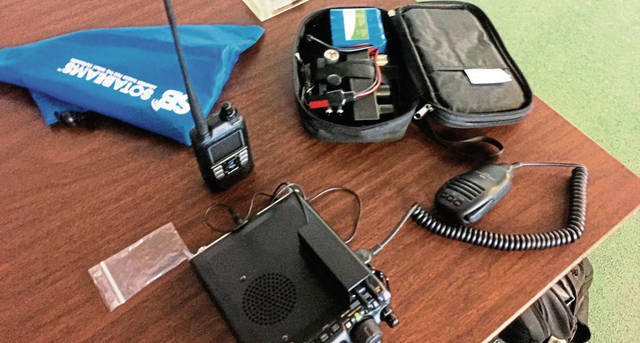
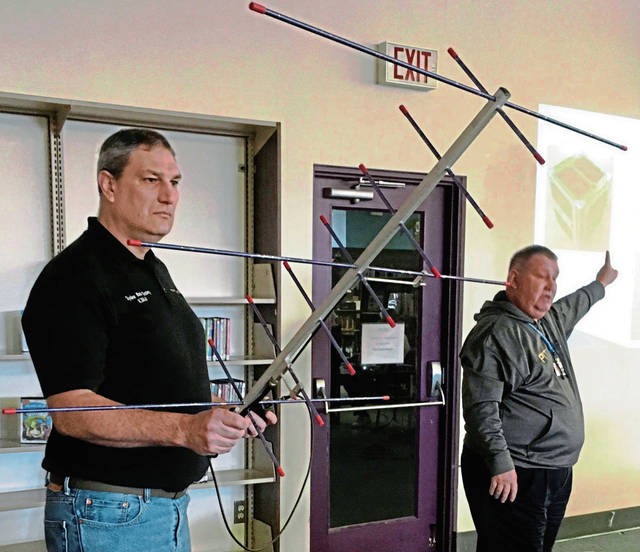
Bastone, Skyview President Bob Dillen of Natrona Heights, Harrison, showed low power, inexpensive radios that can still send a signal that bounces off the ionosphere to reach Europe, Asia and elsewhere.
He showed how Morse code is regaining interest among the estimated 800,000 amateur radio operators in the United States. Skyview has at least 100 members.
Bastone recalls sending a message from Harrisburg to reach a HAM radio operator in France.
“People said that the internet would kill this,” Dillen said.
“Well, the internet has made it five times better. This has a worldwide reach.”
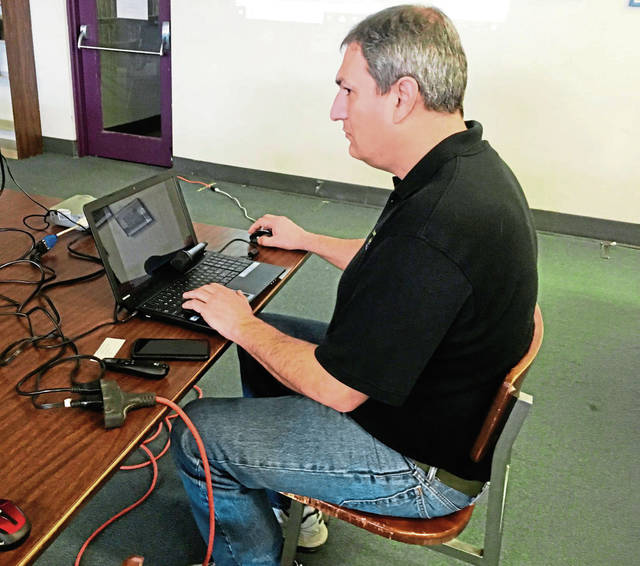
Skyview member John Hoffman of Murrysville demonstrated an internet link.
The dozen-or-so visitors could hear other amateur operators from the laptop’s speaker and then follow the connections displayed on a large screen.
The operator’s “handle,” or station information, is relayed at the beginning and end of each message and every 10 minutes in between.
About 200,000 people are licensed to use Echolink on a computer, Huffman said, and about 6,000 people are available to converse at practically any given time.
Dick Grotenfend of Cheswick has been licensed since 1954.
“It’s a lot of fun. I have enjoyed talking with people in the International Space Station. You know, maybe half of the astronauts are ‘HAMS,’” he said.
Rich Ryba got a HAM radio operator’s license in 2013 when he retired.
“As long as you have the desire to help, age doesn’t matter,” he said. “Young or older doesn’t matter.”
He was part of a team with medics at the Pittsburgh Marathon when three runners dropped out.
“The professional medics handled it. I used my radio to pass on information for them to race officials,” Ryba said.