CAPE CANAVERAL, Fla. — Astronomers have discovered a rare in-sync solar system with six planets moving like a grand cosmic orchestra, untouched by outside forces since their birth billions of years ago.
The find, announced Wednesday, can help explain how solar systems across the Milky Way galaxy came to be. This one is 100 light-years away in the constellation Coma Berenices. A light-year is 5.8 trillion miles.
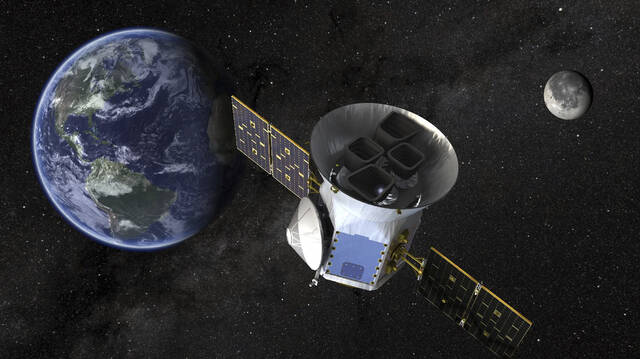
A pair of planet-hunting satellites — NASA’s Tess and the European Space Agency’s Cheops — teamed up for the observations.
None of the planets in perfect synchrony are within the star’s so-called habitable zone, which means little if any likelihood of life, at least as we know it.
“Here we have a golden target” for comparison, said Adrien Leleu of the University of Geneva, who was part of an international team that published the results in the journal Nature.
This star, known as HD 110067, may have even more planets. The six found so far are roughly two to three times the size of Earth, but with densities closer to the gas giants in our own solar system. Their orbits range from nine to 54 days, putting them closer to their star than Venus is to the sun and making them exceedingly hot.
As gas planets, they’re believed to have solid cores made of rock, metal or ice, enveloped by thick layers of hydrogen, according to the scientists. More observations are needed to determine what’s in their atmospheres.
This solar system is unique because all six planets move similar to a perfectly synchronized symphony, scientists said. In technical terms, it’s known as resonance that’s “precise, very orderly,” said co-author Enric Palle of the Institute of Astrophysics of the Canary Islands.
The innermost planet completes three orbits for every two by its closest neighbor. It’s the same for the second- and third-closest planets, and the third- and fourth-closest planets.
The two outermost planets complete an orbit in 41 and 54.7 days, resulting in four orbits for every three. The innermost planet, meanwhile, completes six orbits in exactly the time the outermost completes one.
All solar systems, including our own, are thought to have started out like this one, according to the scientists. But it’s estimated only 1-in-100 systems have retained that synchrony, and ours isn’t one of them. Giant planets can throw things off-kilter. So can meteor bombardments, close encounters with neighboring stars and other disturbances.
While astronomers know of 40 to 50 in-sync solar systems, none have as many planets in such perfect step or as bright a star as this one, Palle said.
The University of Bern’s Hugh Osborn, who was part of the team, was “shocked and delighted” when the orbital periods of this star system’s planets came close to what scientists predicted.
“My jaw was on the floor,” he said. “That was a really nice moment.”