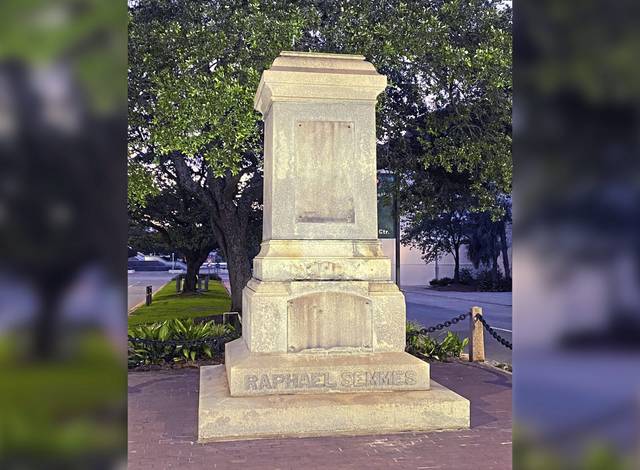
MOBILE, Ala. — A Confederate statue removed from Alabama’s port city earlier this month has been relocated to a museum, the city’s mayor said.
The History Museum of Mobile has received the bronze likeness of Admiral Raphael Semmes, which stood in a middle of a downtown street near the Mobile waterfront for 120 years until June 5, and “will develop a plan to protect, preserve and display” the statue and “place it into the appropriate historic context,” the city’s Mayor Sandy Stimpson said Sunday in multiple Twitter posts.
The decision involved input from city council members and “involved conversations with the Alabama Attorney General’s Office,” Stimpson said on Twitter.
Attorney General Steve Marshall had sent a letter to the mayor after the statue’s removal saying the city could be subject to a $25,000 fine for permanently moving the statue, an action that would violate a state law protecting monuments over 40 years old, AL.com reported.
Marshall’s office has also been pursuing legal actions against the city of Birmingham, about 257 miles north of Mobile, for removing a confederate monument, the news outlet reported. The office plans to “enforce the law consistently against all violators,” his spokesman, Mike Lewis, said in a statement last week.
Stimpson said on Twitter he believes “this action to be consistent” with the state law, and vowed to work with the attorney general’s office if they determine otherwise.
“I have no doubt that moving the statue from public display was the right thing to do for our community going forward,” he said in a post. “The values represented by this monument a century ago are not the values of Mobile in 2020.”
Semmes was a Confederate commerce raider, sinking Union-allied ships during the Civil War. According to the Encyclopedia of Alabama, he was jailed on treason charges in New York City before returning to the South after the war, and was later prohibited by U.S. authorities from taking office as an elected judge in Mobile.
He devoted his later years to writing his memoirs and became a “Lost Cause” hero to Southerners who lamented the end of the Confederacy. The statue was dedicated in 1900, the year before Alabama ratified a Constitution that established white supremacy in the state by essentially disenfranchising blacks and poor whites.