
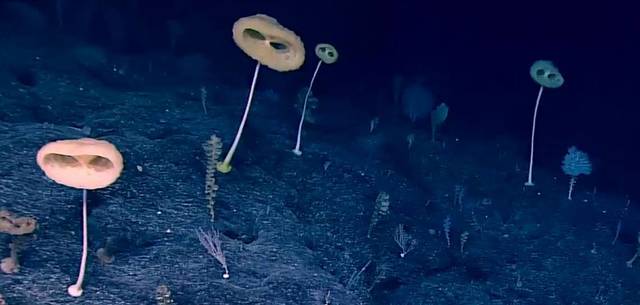
CHARLOTTE, N.C. — A marine creature that resembles the alien E.T. has been found growing in a prehistoric area of eastern Pacific seafloor rock.
The “E.T. sponge” has been classified as a new species and genus, the National Oceanic and Atmospheric Administration said Thursday as it announced the discovery.
The creature was found in “an extraordinary seascape” 7,875 feet down, where strange looking creatures appeared to be growing from the rocky seafloor, NOAA says.
This “Forest of the Weird” — nearly 850 miles southwest of Hawaii — included an “alien-like community” of glass sponges that appeared to look back at the deep sea explorers with pink faces, NOAA reported.
“Rising high on a stalk, this sponge had a body with two large holes oddly reminiscent of the large eyes of the alien from the beloved movie, ‘E.T.: The Extra-Terrestrial,’” NOAA officials said in a release.
The first reported sighting of the glass sponge was in 2016, and credit for the find is going to scientist Cristiana Castello Branco, a postdoctoral researcher who analyzed a specimen’s skeleton and realized it was unknown to science.
She officially named it Advhena magnifica, but everyone is calling it the “E.T. sponge.”
“We usually try to associate the name to something unique about that species, or we can honor someone, the expedition name, or a locality,” Branco said in a release.
“The shape of this sponge is reminiscent of an alien, like in the movies, with what looks like a long thin neck, an elongated head and huge eyes. Advhena is from the Latin advena, which means alien. … While we haven’t ‘officially’ given it a common name in our paper, ‘E.T. sponge’ seems to fit.”
Glass sponges are animals that typically attach themselves to hard surfaces, where they feast on “small bacteria and plankton,” NOAA says.
A sample of the E.T. sponge was taken during a five-hour deep sea dive at the Pigafetta Seamount in the eastern Pacific, NOAA says.
The seamount is a flat-topped area of rock created by volcanic activity, NOAA reports. It is “quite old,” dating to the Cretaceous Period of 65.5 to 145.5 million years ago.