
https://triblive.com/news/world/belarus-frees-nobel-prize-laureate-bialiatski-opposition-figure-kolesnikova-as-u-s-lifts-sanctions/
Belarus frees Nobel Prize laureate Bialiatski, opposition figure Kolesnikova as U.S. lifts sanctions

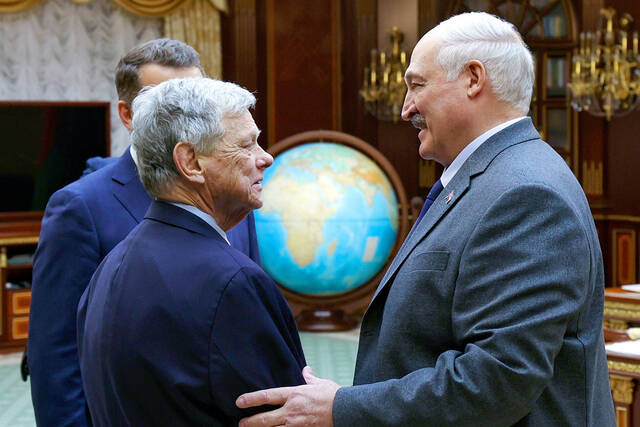
VILNIUS, Lithuania — Belarusian authorities on Saturday freed Nobel Peace Prize laureate Ales Bialiatski, key opposition figure Maria Kolesnikova and other prominent political prisoners, a human rights group confirmed.
Their release comes as authoritarian President Alexander Lukashenko seeks to improve relations with Washington. The U.S. earlier on Saturday announced lifting sanctions on the country’s potash sector. In exchange, Lukashenko pardoned a total of 123 prisoners, the Belta state news agency reported.
A close ally of Russia, Minsk has faced Western isolation and sanctions for years. Lukashenko has ruled the nation of 9.5 million with an iron fist for more than three decades, and the country has been repeatedly sanctioned by Western countries both for its crackdown on human rights and for allowing Moscow to use its territory in the invasion of Ukraine in 2022. Belarus has released hundreds of prisoners since July 2024.
John Coale, the U.S. special envoy for Belarus, announced the lifting of sanctions on potash after meeting Lukashenko in Minsk on Friday and Saturday.
Speaking with journalists, Coale described the two-day talks as “very productive,” Belarus’ state news agency Belta reported Saturday. He said that normalizing relations between Washington and Minsk was “our goal.”
“We’re lifting sanctions, releasing prisoners. We’re constantly talking to each other,” he said, according to Belta. He also said that the relationship between the countries was moving from “baby steps to more confident steps” as they increased dialogue.
Bialiatski and Kolesnikova among those released
Pavel Sapelka, an advocate with the Viastan rights group, confirmed to The Associated Press that Bialiatski and Kolesnikova were released from prison.
Human rights advocate Bialiatski won the Nobel Peace Prize in 2022, along with the prominent Russian rights group Memorial and Ukraine’s Center for Civil Liberties.
Bialiatski, awarded the prize while in jail awaiting trial, was later convicted of smuggling as well as financing actions that violate public order — charges widely denounced as politically motivated — and sentenced to 10 years in 2023.
Kolesnikova was a key figure in the mass protests that rocked Belarus in 2020, and is a close ally of an opposition leader in exile, Sviatlana Tsikhanouskaya.
Kolesnikova, known for her close-cropped hair and trademark gesture of forming a heart with her hands, became an even greater symbol of resistance when Belarusian authorities tried to deport her in September 2020. Driven to the Ukrainian border, she briefly broke away from security forces at the frontier, tore up her passport and walked back into Belarus.
The 43-year-old professional flautist was convicted in 2021 on charges including conspiracy to seize power and sentenced to 11 years in prison.
Others who were freed
Others who were released, according to Viasna, include Viktar Babaryka — an opposition figure who had sought to challenge Lukashenko in the 2020 presidential election, widely seen as rigged, before being convicted and sentenced to 14 years in prison on charges he rejected as political.
Viasna said that the group’s imprisoned advocates, Valiantsin Stefanovic and Uladzimir Labkovich, and prominent opposition figure Maxim Znak, were released as well.
Most of them were brought into Ukraine, Franak Viachorka, Tsikhanouskaya’s senior adviser, told the AP.
“I think Lukashenko decided to deport people to Ukraine to show that he is in control of the situation,” Viachorka said.
Eight or nine others, including Bialiatski, will be brought to Lithuania on Saturday, and more prisoners will be taken to Lithuania in the next few days, Viachorka said.
Ukrainian authorities confirmed that Belarus handed over 114 civilians. Ukrainian President Volodymyr Zelenskyy said five of them were Ukrainian nationals.
Lukashenko wants a rapprochement with the West
The last time U.S. officials met with Lukashenko in September 2025, Washington announced easing some of the sanctions against Belarus while Mink released more than 50 political prisoners into Lithuania. With that September release, the number of prisoners freed by Belarus since July 2024 exceeded 430, in what was widely seen as an effort at a rapprochement with the West.
“The freeing of political prisoners means that Lukashenko understands the pain of Western sanctions and is seeking to ease them,” Tsikhanouskaya told the AP on Saturday.
She added: “But let’s not be naive: Lukashenko hasn’t changed his policies, his crackdown continues and he keeps on supporting Russia’s war against Ukraine. That’s why we need to be extremely cautious with any talk of sanctions relief, so that we don’t reinforce Russia’s war machine and encourage continued repressions.”
Tsikhnouskaya also described European Union sanctions against Belarusian potash fertilizers as far more painful for Minsk that those imposed by the U.S, saying that while easing U.S. sanctions could lead to the release of political prisoners, European sanctions should push for long-term, systemic changes in Belarus and the end of Russia’s war in Ukraine.
Sanctions have hit the key Belarus export hard
Belarus, which previously accounted for about 20% of global potash fertilizer exports, has faced sharply reduced shipments since Western sanctions targeted state producer Belaruskali and cut off transit through Lithuania’s Klaipeda port, the country’s main export route.
“Sanctions by the U.S., EU and their allies have significantly weakened Belarus’s potash industry, depriving the country of a key source of foreign exchange earnings and access to key markets,” Anastasiya Luzgina, an analyst at the Belarusian Economic Research Center BEROC, told AP.
“Minsk hopes that lifting U.S. sanctions on potash will pave the way for easing more painful European sanctions; at the very least, U.S. actions will allow discussions to begin,” she said.
The latest round of U.S.-Belarus talks also touched on Venezuela, as well as Russia’s ongoing invasion of Ukraine, Belta reported.
Coale told reporters that Lukashenko had given “good advice” on how to address the Ukraine war, saying that Lukashenko and Russian President Vladimir Putin were “longtime friends” with “the necessary level of relationship to discuss such issues.”
“Naturally, President Putin may accept some advice and not others,” Coale said.
Copyright ©2026— Trib Total Media, LLC (TribLIVE.com)