President Joe Biden on Monday will reveal the first image from NASA’s new space telescope — the deepest view of the cosmos ever captured.
The first image from the $10 billion James Webb Space Telescope is going to show the farthest humanity has ever seen in both time and distance, closer to the dawn of the universe and the edge of the cosmos. That image will be followed Tuesday by the release of four more galactic beauty shots from the telescope’s initial outward gazes.
NASA said Biden will show a “deep field” image. That shot is likely to be be filled with lots of stars, with massive galaxies in the foreground distorting the light of the objects behind, telescoping them and making faint and extremely distant galaxies visible. Part of the image will be of light from not too long after the Big Bang.
The images to be released Tuesday include a view of a giant gaseous planet outside our solar system, two images of a nebula where stars are born and die in spectacular beauty and an update of a classic image of five tightly clustered galaxies that dance around each other.
You can watch the live event at 5 p.m. Monday on NASA Television.
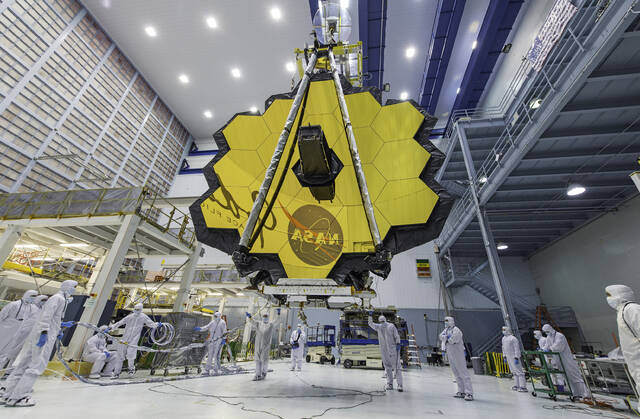
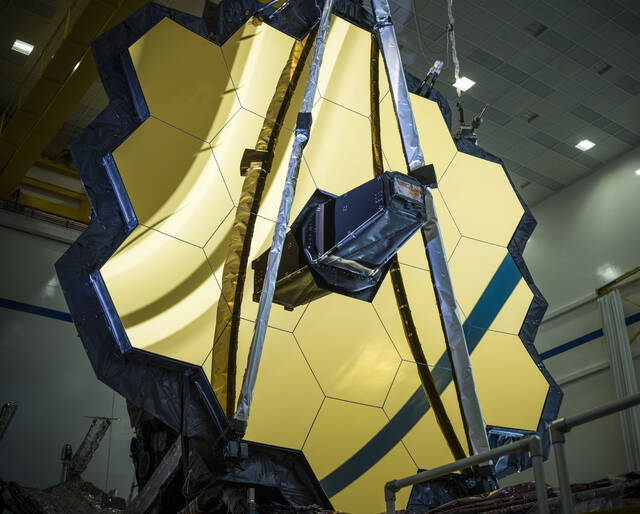
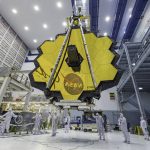
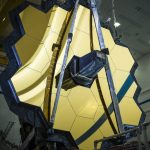
The world’s biggest and most powerful space telescope rocketed away last December from French Guiana in South America. It reached its lookout point 1 million miles from Earth in January. Then the lengthy process began to align the mirrors, get the infrared detectors cold enough to operate and calibrate the science instruments, all protected by a sunshade the size of a tennis court that keeps the telescope cool.
The plan is to use the telescope to peer back so far that scientists will get a glimpse of the dawn of the universe about 13.7 billion years ago and zoom in on closer cosmic objects, even our own solar system, with sharper focus.
Webb is considered the successor to the highly successful, but aging Hubble Space Telescope. Hubble has stared as far back as 13.4 billion years. It found the light wave signature of an extremely bright galaxy in 2016.
Thomas Zurbuchen, NASA’s science mission chief said, with the new telescope, the cosmos is “giving up secrets that had been there for many, many decades, centuries, millennia.”
“It’s not an image. It’s a new world view that you’re going to see,” he said during a recent media briefing.
Zurbuchen said when he saw the images he got emotional and so did his colleagues: “It’s really hard to not look at the universe in new light and not just have a moment that is deeply personal.”
NASA is collaborating on Webb with the European and Canadian space agencies.