
https://triblive.com/news/world/eliminating-irans-ballistic-missiles-could-prove-to-be-difficult/
Eliminating Iran’s ballistic missiles could prove to be difficult

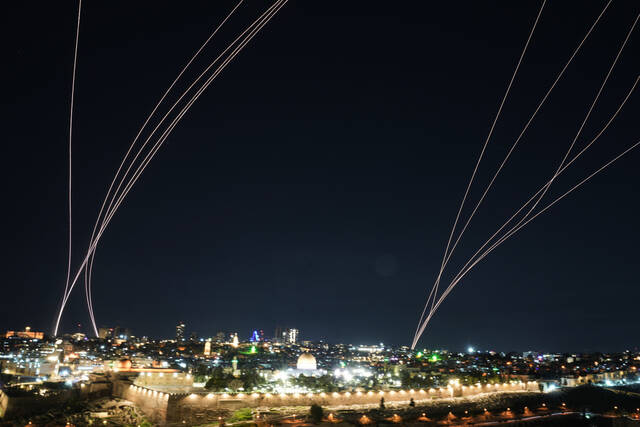
WASHINGTON — At the White House on Monday, President Donald Trump said that destroying Iran’s missile capabilities was one of the top objectives of the U.S. attacks in the country.
But finding and destroying Iran’s entire arsenal of ballistic missiles as well as their production sites could be particularly challenging for the U.S. and Israeli militaries, which jointly began attacking Iran on Saturday.
Airstrikes alone cannot destroy the plans and know-how for building those weapons, and Iran has proved adept at acquiring the necessary equipment to restart production lines, placing at least some of them underground in fortified facilities. The Iranians have also shown that they can break their ballistic missiles apart into smaller pieces that are more easily smuggled to proxy forces and reassembled for use — potentially making the task of finding them all much more difficult.
In January, Israeli officials said Iran had largely rebuilt its ballistic missile program after the 12-day war last June. And U.S. Central Command said in a social media post Sunday that it had used B-2 stealth bombers to attack “hardened ballistic missile facilities” with 2,000-pound bombs. Gen. Dan Caine, chair of the Joint Chiefs of Staff, acknowledged Monday that the sites were underground.
Over decades, Iran has developed a wide range of missiles that can hit targets well beyond its borders.
They include different types of ballistic missiles, which follow an arcing path high into the atmosphere and then use gravity to reach velocities many times faster than the speed of sound. Iran’s longest-range ballistic missile can strike targets about 1,200 miles away.
In 2019, the Defense Intelligence Agency said Iran possessed “the largest and most diverse ballistic missile arsenal in the Middle East.”
On Sunday, Israel claimed that it had destroyed roughly 200 of Iran’s ballistic missile launchers and damaged dozens more, but Iranian forces have continued to launch ballistic missiles into neighboring countries.
In Washington on Monday, Secretary of State Marco Rubio said the United States would continue to strike Iran until it had achieved its objectives, including destroying Iran’s ballistic missile capabilities.
“The military is doing its darnedest to hit these things,” Tom Karako, director of the Missile Defense Project at the Center for Strategic and International Studies, said in an interview. “We probably have a pretty good idea of where they are, but the ability to get everything and then to know that you’ve got from a battle damage assessment point of view is going to be hard — especially to do that from the air.”
Eliminating Iran’s underground missiles and production facilities, Karako added, could involve deploying U.S. or Israeli special forces troops on the ground to inspect known or suspected sites.
From 1987 to 2019, the United States was bound by the Intermediate-Range Nuclear Forces Treaty and gave up much of the Pentagon’s nonnuclear ballistic missiles as a result.
Since the United States and Russia formally exited the treaty, the Pentagon has accelerated the development of new ballistic missiles, such as the Precision Strike Missile, which in tests has flown past the 310-mile range that would have previously been banned.
By comparison, Iran, which was never party to the INF Treaty, has built an arsenal of ballistic missiles categorized as “close-range” that can hit targets from about 30 to 190 miles away, “short-range” weapons that fly 190 to 620 miles, and “medium-range” missiles that have a maximum range of about 1,240 miles.
Trump said in his State of the Union address last Tuesday that he was concerned Iran was developing the longest-range category — “intercontinental” ballistic missiles, or ICBMs. Classified assessments by the U.S. intelligence community, however, disputed that notion, saying that Iran was at least a decade away from developing ICBMs.
The 2019 report from the Defense Intelligence Agency explained that Iran pursued ballistic missiles in part because it lacked a modern air force. The missiles gave the country “a long-range strike capability to dissuade its adversaries in the region — particularly the United States, Israel, and Saudi Arabia — from attacking Iran.”
One of the best insights into Iran’s ballistic missile program came from the interdiction of small vessels smuggling weapons from Iran to Houthi fighters in Yemen.
According to a February 2024 report from the Defense Intelligence Agency, U.S. and Yemeni forces interdicted 18 vessels smuggling Iranian weapons, including ballistic missiles, to Houthi fighters between 2015 and 2023.
The Houthis’ arsenal has included several Iranian ballistic missiles, including the Fateh-110, which has a 190-mile range, the Qiam-1 with a 750-mile range and the 1,200-mile Shahab-3, the report said.
The 2019 DIA report noted that Tehran’s “desire to have a strategic counter” to the U.S. may drive an effort to develop ICBMs in the future.
Focusing on locating and destroying ballistic missiles from the sky is not new for the Pentagon.
During Operation Desert Storm in 1991, the U.S. military created a special cell to search for Iraqi “Scud” short-range ballistic missiles. But the effort “met with remarkably little success,” a later CIA report said.
Allied pilots, the report said, “were notoriously optimistic” about the success of their Scud-hunting attack missions.
Copyright ©2026— Trib Total Media, LLC (TribLIVE.com)