BRUSSELS — The European Union unveiled plans Wednesday to revamp Europe’s ID check-free travel area after national coronavirus restrictions placed new strains on tourism, travel and business throughout the bloc over the last year.
The travel zone, known as the “Schengen area,” is made up of 26 countries: 22 EU nations plus Iceland, Liechtenstein, Norway and Switzerland. Normally, people and goods move freely between these countries without border checks.
Panicked by Italy’s coronavirus outbreak in February last year, some Schengen countries imposed border restrictions without consulting their neighbors to try to keep the disease out. The moves caused massive traffic jams and blocked key medical equipment from getting across borders. Nineteen countries put border restrictions in place.
Free movement is a pillar of European integration. It helps businesses flourish and many officials worry that the future of the Schengen area is under threat from virus travel restrictions. Those measures have added to border pressures already caused by the arrival in Europe of well over 1 million migrants in 2015.
The new strategy aims to beef up Europe’s external borders, through the Frontex border agency and a state-of-the-art digitalized entry and exit system to keep an eye on who enters or leaves. Cooperation between police and national security agencies and improved visa policies are also foreseen.
The EU’s executive branch, the European Commission, said its proposals involve an improved system of monitoring to help restore trust between member countries. Brussels argues that countries would be less inclined to put restrictions in place if they’re confident their neighbors are acting properly.
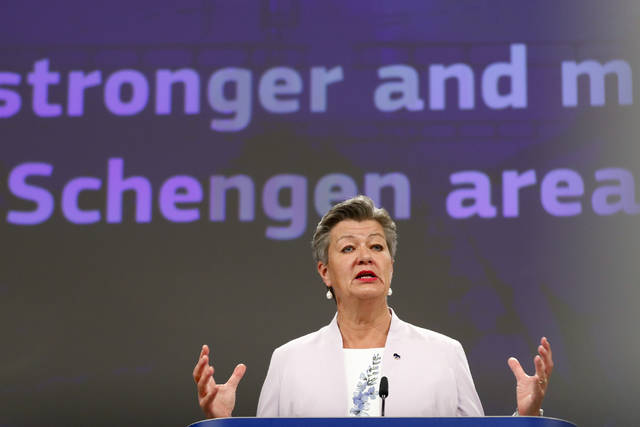
“Terrorism will not end. We will have new pandemics probably, we will have other challenges coming,” EU Home Affairs Commissioner Ylva Johansson told reporters as she unveiled the plans.
“What we need is to prepare the governance of the whole Schengen area to be able to face and address these challenges, to secure our citizens while also having free movement,” Johansson said. “We are not stronger than our weakest link.”
Another goal is to enlarge the Schengen zone, bringing EU countries Bulgaria, Romania, Croatia and Cyprus into it.
Around 420 million people live in the Schengen zone. Almost 1.7 million people reside in one Schengen nation and work in another, while an estimated 3.5 million people in Europe cross what were once permanent border crossings every day.
At least 8 countries currently have some restrictions in place, either due to coronavirus prevention or security reasons. Restrictions are meant to last no longer than 6 months but some countries — notably Austria, France and Denmark — routinely renew them and have done so for years.
The Commission estimates that border restrictions and closures can result in additional costs of $6 billion to 22 billion a year.