NATIONAL PARK, N.J. — Researchers believe they have uncovered in a mass grave in New Jersey the remains of as many as 12 Hessian soldiers who fought during the Revolutionary War, officials announced Tuesday.
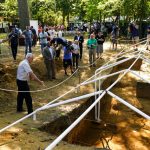
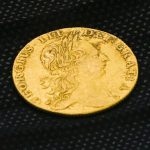
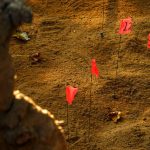
The remains, found at the site of Fort Mercer and the 1777 Battle of Red Bank, rested for 245 years until a human femur was found in June during an archaeological dig of a trench system that surrounded the fort, scientists said. Additional excavation yielded more skeletal remains and items including pewter and brass buttons and a King George III gold guinea, which would have been a soldier’s pay for a month.
A team of scientists from Rowan University and officials from Gloucester County presented their preliminary findings during a news conference at Red Bank Battlefield Park, just south of Philadelphia.
Officials believe the remains are part of a mass grave of Hessian soldiers — German troops hired by the British — who were part of about 377 troops killed by Colonial forces during the Battle of Red Bank. Americans lost 14, historians said.
The victory allowed Americans at the fort to delay the British from moving supplies up the Delaware River.
“Based on everything we’ve found and the context of what we’ve found, these appear to be Hessians,” Wade Catts, principal archaeologist for South River Heritage Consulting of Delaware, said in a statement.
The remains have been turned over to forensic anthropologists at the New Jersey State Police forensic unit to extract DNA from the bones and teeth to identify their origin. Additional studies are being conducted to examine life history, health and disease.
The scientists hope they can identify the remains and find their descendants.
“We’re hoping that eventually, perhaps, we can find some of these individuals,” Rowan University public historian Jennifer Janofsky said in a statement. “If we can extract their stories, and if we can tell their stories, it lets us put a name to a face. And that, to me, is a very powerful moment in public history.”
Officials said the remains were excavated with “extraordinary attention” to preserving the dignity of war dead.
When the study is complete, they will be interred at another site, and the trench will be refilled. The land will be incorporated into the park on a bluff overlooking the river.
“Archaeology is helping us better understand what happened on the battlefield,” Janofsky said.