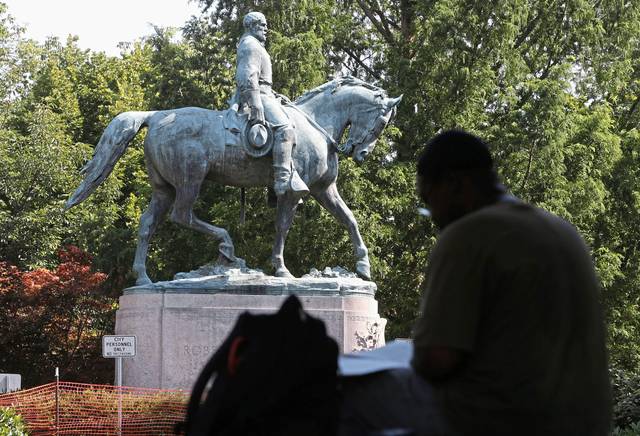
RICHMOND, Va. — Virginia’s highest court ruled Thursday that the city of Charlottesville can take down two statues of Confederate generals, including one of Robert E. Lee that became the focus of a violent white nationalist rally in 2017.
The state Supreme Court overturned a Circuit Court decision in favor of a group of residents who sued to block the city from taking down the Lee statue and a nearby monument to fellow Gen. Thomas J. “Stonewall” Jackson. Charlottesville’s city council voted to remove both.
White supremacist and neo-Nazi organizers of the August 2017 “Unite the Right” rally in Charlottesville said they went to the city to defend the statue of Lee. They clashed with counterprotesters before a man plowed his car into a crowd of people, killing a woman.
The Jackson statue was erected in Jackson Park in 1921 and the Lee statue was erected in Lee Park in 1924. In 1918, the city had accepted a resident’s offer to donate land for parks for both statutes.
In Thursday’s decision, State Supreme Court Justice Bernard Goodwyn said both statues were erected long before the passage of a law regulating the “disturbance of or interference with” war memorials or monuments.
“In other words, (the law) did not provide the authority for the City to erect the Statues, and it does not prohibit the City from disturbing or interfering with them,” Goodwyn wrote.
S. Braxton Puryear, one of the attorneys for the residents who sued, said he hadn’t read the ruling yet and couldn’t immediately comment on it.
A spokesman for the city of Charlottesville didn’t immediately respond to a call and email seeking comment on the court’s ruling.
The Virginia Division of the Sons of Confederate Veterans, Inc., and The Monument Fund, Inc., also were plaintiffs in the lawsuit filed against the city in March 2017.
Plaintiffs’ attorneys argued that a law enacted by the state’s General Assembly in 1997 prevented the city from removing the two Confederate statues. The city argued that the law couldn’t be applied retroactively and did not apply to statues that cities erected before 1997.
The state Supreme Court agreed with the city, concluding there is no language in the statute that demonstrates the General Assembly intended for the law to apply to monuments or memorials that cities erected before 1997.
“The circuit court erred in failing to interpret the statute according to its plain language meaning,” Goodwyn wrote.
The state Supreme Court also ruled that the circuit court erred in ordering the city to pay for the plaintiffs’ attorneys’ fees and costs.