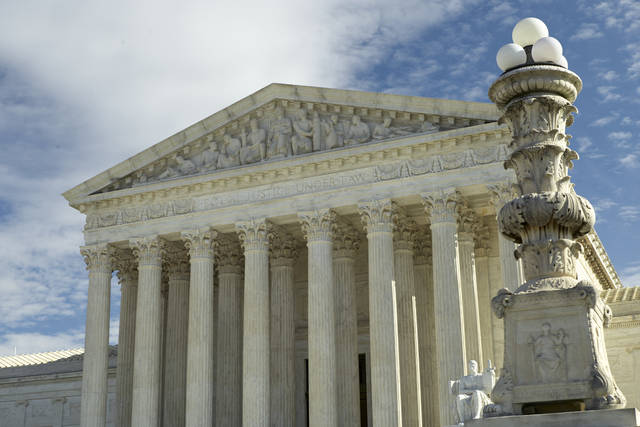
The Supreme Court wrestled Tuesday with whether to make it easier for the president to fire the head of the agency that enforces federal consumer financial laws, a decision that could ultimately impact a vast range of agencies.
The high court was hearing arguments in a case involving the Consumer Financial Protection Bureau, the agency Congress created in response to the 2008 financial crisis.
The agency was the brainchild of Massachusetts senator and Democratic presidential candidate Elizabeth Warren, and arguments took place as voters in 14 states were selecting who they want to be the Democratic party’s nominee for president.
During arguments at the high court some justices were clearly bothered by a restriction that keeps the president from firing the CFPB’s head whenever he wants. Justice Brett Kavanaugh called that restriction “troubling.” But other justices seemed willing to let the restriction stand, including Justice Ruth Bader Ginsburg, who described the restrictions as “modest.”
Under the Dodd-Frank Act that created the CFPB, its director is appointed by the president and confirmed by the Senate to a five-year term. The president can only remove a director for “inefficiency, neglect of duty or malfeasance in office.” That means that an incoming president usually can’t immediately fire the agency’s head appointed in the previous administration.
Defenders of the bureau’s structure say it is good in that it insulates the agency’s head from pressure by the president. But detractors say the restriction is unconstitutional and improperly limits the power of the president.
The impact of the justices’ decision in the case could go beyond the CFPB because the heads of other so-called independent agencies have a similar restriction on being fired. Those agencies include the Federal Reserve, Federal Deposit Insurance Corporation, Federal Trade Commission, Federal Communications Commission and Securities and Exchange Commission. Unlike the CFPB, however, those agencies are headed by multi-member boards.
The case was brought to the court by the Orange County, California-based consumer law firm Seila Law. As part of an investigation, the CFPB demanded information and documents from the firm, which is run by a solo practitioner. Seila Law responded by challenging the CFPB’s structure. Two lower courts ruled against the law firm.
The Obama administration initially defended the structure of the agency. The Trump administration later reversed course and now says the structure is unconstitutional.
A decision in the case, Seila Law LLC v. Consumer Financial Protection Bureau, 19-7, is expected by the end of June.