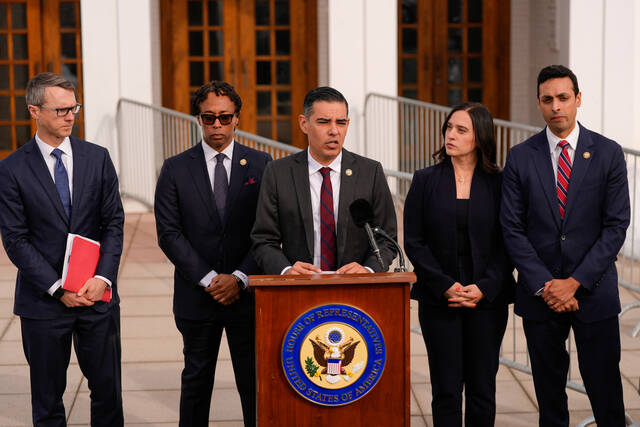
WASHINGTON — House Republicans on Monday filed a lawsuit against Attorney General Merrick Garland for the audio recording of President Joe Biden’s interview with a special counsel in his classified documents case, asking the courts to enforce their subpoena and reject the White House’s effort to withhold the materials from Congress.
The lawsuit filed by the House Judiciary Committee marks Republicans’ latest broadside against the Justice Department as partisan conflict over the rule of law animates the 2024 presidential campaign. The legal action comes weeks after the White House blocked Garland from releasing the audio recording to Congress by asserting executive privilege.
Republicans in the House responded by voting to make Garland the third attorney general in U.S. history to be held in contempt of Congress. But the Justice Department refused to take up the contempt referral, citing the agency’s “longstanding position and uniform practice” to not prosecute officials who don’t comply with subpoenas because of a president’s claim of executive privilege.
The congressional inquiry began with the release of special counsel Robert Hur’s report in February, which found evidence that Biden, a Democrat, willfully retained and shared highly classified information when he was a private citizen. Yet Hur concluded that criminal charges were not warranted.
Republicans, incensed by Hur’s decision, issued a subpoena for audio of his interviews with Biden during the spring. But the Justice Department turned over only some of the records, leaving out audio of the interview with the president.
On the last day to comply with the Republicans’ subpoena for the audio, the White House blocked the release by invoking executive privilege. It said that Republicans in Congress only wanted the recordings “to chop them up” and use them for political purposes.
Executive privilege gives presidents the right to keep information from the courts, Congress and the public to protect the confidentiality of decision-making, though it can be challenged in court. Administrations of both major political parties have long held the position that officials who assert a president’s claim of executive privilege can’t be prosecuted for contempt of Congress, a Justice Department official told Republicans last month.
Assistant Attorney General Carlos Felipe Uriarte cited a committee’s decision in 2008 to back down from a contempt effort after President George W. Bush asserted executive privilege to keep Congress from getting records involving Vice President Dick Cheney.
It’s unclear how the lawsuit will play out. Courts have not had much to say about executive privilege. But in the 1974 case over President Richard Nixon’s refusal to release Oval Office recordings as part of the Watergate investigation, the Supreme Court held that the privilege is not absolute. In other words, the case for turning over documents or allowing testimony may be more compelling than arguments for withholding them. In that context, the court ruled 8-0 that Nixon had to turn over the tapes.
When it came to the Watergate tapes, the Supreme Court said it had the final word, and lower courts have occasionally weighed in to resolve other disputes. But courts also have made clear they prefer that the White House and Congress resolve their disagreements without judicial intervention, when possible.