ON OMAHA BEACH, France — Warships, bombers, rubble, refugees. That was the Normandy landscape of 1944, as Allied forces fought to wrest France from Nazi control.
Today, the region’s towns and beaches are startlingly calm, as still-grateful residents prepare to welcome veterans commemorating 75 years since D-Day.
The Associated Press revisited the beaches and damaged villages that symbolize the Allied struggle.
On Omaha Beach on June 6, 1944 , layer upon layer of U.S., British and Canadian warships lined up along the Normandy shore. German anti-tank obstacles packed the broad beaches. Lethal aircraft dotted the sky.
Today, a grassy knoll blends gently into the wide beach, small waves lapping at the shore. Two tourists stand alone on the vast expanse.
But D-Day was just Day One. The battle for Normandy took two-and-a-half more months, leveling near-entire towns, and gutting medieval monuments.
Putrefied corpses once scattered the streets of the town of Saint-Lo. Helmeted U.S. soldiers watched out from a makeshift trench, a mountain of crumbled stone behind them. Today, that rubble is the rebuilt Saint-Lo Church.
The Allies liberated one of France’s most striking monuments, the Mont-Saint-Michel peninsula monastery, from Nazi rule in the weeks after D-Day. It now sees 2 million tourists a year.
Much of the architectural damage to Normandy came not from Nazi occupation but from Allied bombings.
Soldiers placed a steel beam across a ditch in Pont-L’Eveque to walk past the 15th century St. Michel Church, its lonely arches leading to nowhere after their surrounding walls collapsed. Now, neatly trimmed hedges line the polished stone walls of the restored monument.
In Saint-Hilaire-du-Harcouet, the twin-towered St. Hilaire Church was among the only buildings left standing. The surrounding neighborhood has since revived, with tidy brick homes and an insurance office boasting a sign saying “English spoken.”
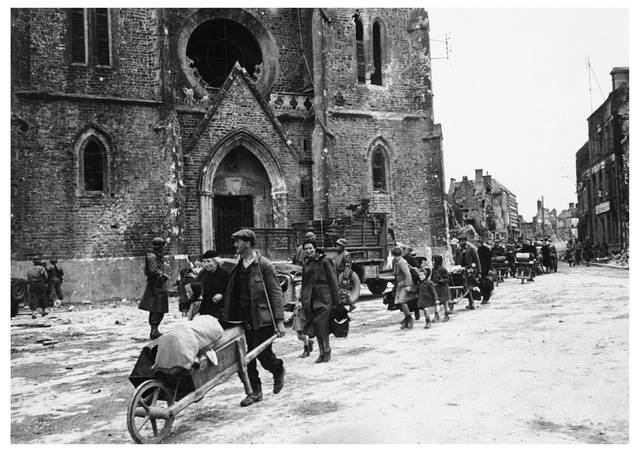
The bombings sent thousands of residents into hiding. After the Nazis were pushed out of La Haye-du-Puits in July 1944, residents cautiously walked home, pushing their belongings in wheelbarrows past the blown-out rose windows of the St. Jean Church. The church shows little hint of the damage today, and well-tended orange and yellow flowers grow along its facade.
Normandy has been buffeted by battles since Roman times, and soldiers marching through Sainte-Marie-du-Mont in 1944 saw a reminder of that troubled past: a monument to townsmen killed in World War I.
Today, the monument has been updated to honor those killed in the Second World War, which the town hopes will be its last.