MOSCOW — The Russian Foreign Ministry on Wednesday rejected U.S. arguments for fielding low-yield nuclear warheads, warning that an attempt to use such weapons against Russia would trigger an all-out nuclear retaliation.
The U.S. State Department argued in a paper released last week that fitting the low-yield nuclear warheads to submarine-launched ballistic missiles would help counter potential new threats from Russia and China. It charged that Moscow in particular was pondering the use of non-strategic nuclear weapons as a way of coercion in a limited conflict — an assertion that Russia has repeatedly denied.
The State Department noted that the new supplemental warhead “reduces the risk of nuclear war by reinforcing extended deterrence and assurance.”
The Russian Foreign Ministry sees it otherwise.
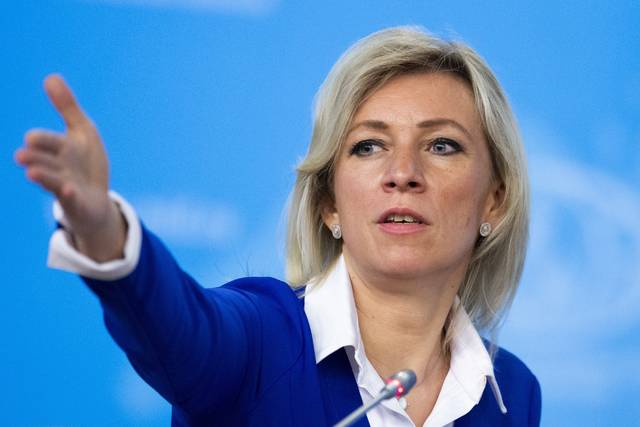
The ministry’s spokeswoman, Maria Zakharova, commented on the State Department’s paper at a briefing on Wednesday, emphasizing that the U.S. shouldn’t view its new low-yield warheads as a flexible tool that could help avert an all-out nuclear conflict with Russia.
“Any attack involving a U.S. submarine-launched ballistic missile (SLBM), regardless of its weapon specifications, would be perceived as a nuclear aggression,” Zakharova said. “Those who like to theorize about the flexibility of American nuclear potential must understand that in line with the Russian military doctrine such actions are seen as warranting retaliatory use of nuclear weapons by Russia.”
Zakharova cast the U.S. deployment of low-yield warheads as a destabilizing move that would result in “lowering the nuclear threshold.”
U.S.-Russian differences on nuclear arms issues come as relations between Moscow and Washington are at post-Cold War lows over the Ukrainian crisis and the accusations of Russian meddling in the U.S. 2016 presidential election.
Last year, both Moscow and Washington withdrew from the 1987 Intermediate-range Nuclear Forces Treaty.
The only U.S.-Russian nuclear arms control agreement still standing is the New START treaty, which was signed in 2010 by U.S. President Barack Obama and then-Russian President Dmitry Medvedev. The pact limits each country to no more than 1,550 deployed nuclear warheads and 700 deployed missiles and bombers and envisages sweeping on-site inspections to verify the compliance.
Russia has offered to extend the New START that expires in February 2021, while the Trump administration has pushed for a new arms control pact that would also include China. Moscow has described that idea as unfeasible, pointing at Beijing’s refusal to negotiate any deal that would reduce its much smaller nuclear arsenal.
In a statement Wednesday marking the 10th anniversary of signing the New START, the Russian Foreign Ministry hailed the treaty as an instrument that helps ensure predictability in the nuclear sphere and reaffirmed Moscow’s offer to extend it without any preconditions.