

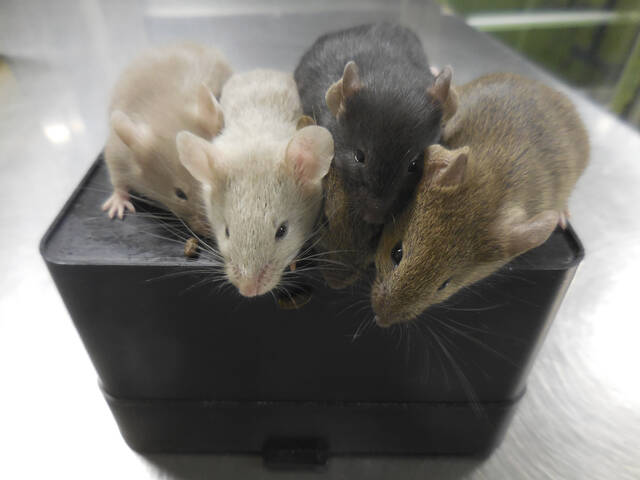
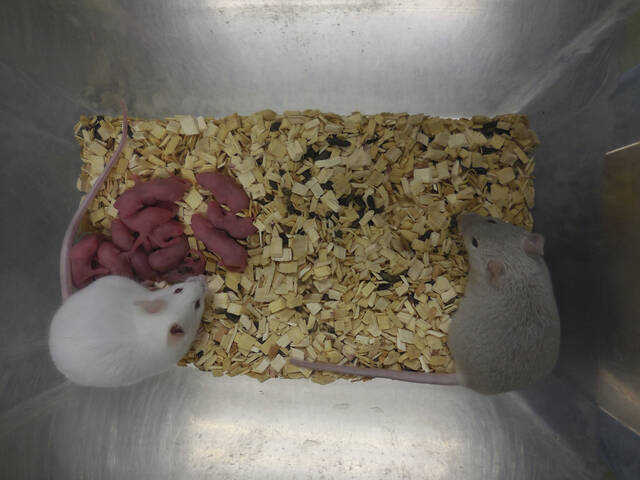

For the first time, scientists have created baby mice from two males.
This raises the distant possibility of using the same technique for people — although experts caution that very few mouse embryos developed into live mouse pups and no one knows whether it would work for humans.
Still, “It’s a very clever strategy,” said Diana Laird, a stem cell and reproductive expert at the University of California, San Francisco, who was not involved in the research. “It’s an important step in both stem cell and reproductive biology.”
Scientists described their work in a study published recently in the journal Nature.
First, they took skin cells from the tails of male mice and transformed them into “induced pluripotent stem cells,” which can develop into many different types of cells or tissues. Then, through a process that involved growing them and treating them with a drug, they converted male mouse stem cells into female cells and produced functional egg cells. Finally, they fertilized those eggs and implanted the embryos into female mice. About 1% of the embryos — 7 out of 630 — grew into live mouse pups.
The pups appeared to grow normally and were able to become parents themselves in the usual way, research leader Katsuhiko Hayashi of Kyushu University and Osaka University in Japan told fellow scientists at the Third International Summit on Human Genome Editing last week.
In a commentary published alongside the Nature study, Laird and her colleague, Jonathan Bayerl, said the work “opens up new avenues in reproductive biology and fertility research” for animals and people. Down the road, for example, it might be possible to reproduce endangered mammals from a single male.
“And it might even provide a template for enabling more people,” such as male same-sex couples, “to have biological children, while circumventing the ethical and legal issues of donor eggs,” they wrote.
But they raised several cautions. The most notable one? The technique is extremely inefficient. They said it’s unclear why only a tiny fraction of the embryos placed into surrogate mice survived; the reasons could be technical or biological. They also stressed that it’s still too early to know if the protocol would work in human stem cells at all.
Laird also said scientists need to be mindful of the mutations and errors that may be introduced in a culture dish before using stem cells to make eggs.
The research is the latest to test new ways to create mouse embryos in the lab. Last summer, scientists in California and Israel created “synthetic” mouse embryos from stem cells without a dad’s sperm or a mom’s egg or womb. Those embryos mirrored natural mouse embryos up to 8½ days after fertilization, containing the same structures, including one like a beating heart. Scientists said the feat could eventually lay the foundation for creating synthetic human embryos for research in the future.


