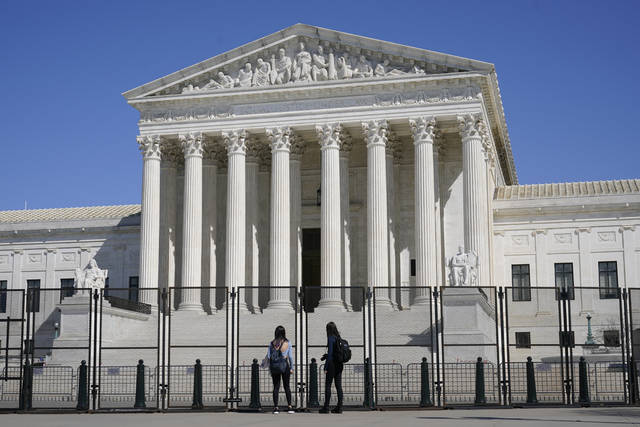
WASHINGTON — The Supreme Court seemed likely Tuesday to allow tribal police officers to stop and search non-Indians on tribal lands over concerns that drunk drivers or even violent criminals might otherwise elude authorities.
The justices heard arguments in the Justice Department’s appeal of a lower court ruling that threw out evidence of drug-related crimes from the search of a non-Native motorist’s pickup truck by a tribal officer on a public road that crosses the Crow reservation in Montana.
The case involves a traffic stop in 2016 in which Officer James Saylor of the Crow Tribe Police Department came upon a pickup truck with its headlights on and motor running, parked on the shoulder of U.S. Route 212.
The driver, Joshua Cooley, had watery, bloodshot eyes, Saylor said. Cooley also had two semiautomatic rifles and a handgun in the pickup, as well as methamphetamine.
Saylor called for help from federal and county officers, who eventually arrested Cooley.
Tribal police have limited authority over non-Indians in criminal matters, and the question for the high court is whether non-Indians can be detained only if evidence of a crime is “apparent” or “obvious,” as the 9th U.S. Circuit Court of Appeals held.
But several justices suggested that the 9th Circuit went too far in limiting tribal police.
“What if it is a situation where he has reasonable suspicion that this person is a murderer?” Justice Samuel Alito asked Cooley’s lawyer, Eric Henkel.
The officer must let the driver go in such a situation, Henkel said. “No, I don’t think he has enough because reasonable suspicion is such a low threshold,” Henkel said.
Chief Justice John Roberts said that even as the court has limited tribes’ ability to deal with non-Indians, it has recognized that tribes retain some inherent authority.
“What could threaten that more than the idea that you can’t do anything about somebody within the reservation that you have good reason to believe is violating criminal law?” Roberts asked.
Indian tribes can’t use their own courts to hold non-Indians accountable for crimes committed on reservations.
But Justice Department lawyer Eric Feigin said a tribal officer should be able to detain and hand over someone to federal or state authorities. “If the state or the federal government says, no, we don’t want this person, the tribe has to let him go,” Feigin said.
Siding with the federal government and Indian tribes, former federal prosecutors appointed by both Democratic and Republican presidents told the court in a written filing that Indian country criminal jurisdiction is “a confounding morass for tribal, federal, and state authorities.”
A decision is expected by late June.