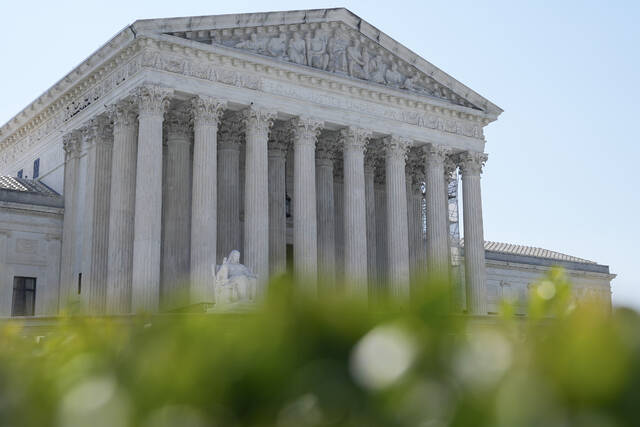
WASHINGTON — The Supreme Court on Thursday upheld the conviction of a California woman who said she did not know about a stash of methamphetamine hidden inside her car.
In a ruling that crossed the court’s ideological lines, the 6-3 majority opinion dismissed arguments that an expert witness for the prosecution had gone too far in describing the woman’s mindset when he said that most larger scale drug couriers are aware of what they are transporting.
“An opinion about most couriers is not an opinion about all couriers,” said Justice Clarence Thomas, who wrote the decision. He was joined by fellow conservatives Chief Justice John Roberts, Justices Samuel Alito, Brett Kavanaugh and Amy Coney Barrett as well as liberal Justice Ketanji Brown Jackson.
In a sharp dissent, conservative Justice Neil Gorsuch wrote that the ruling gives the government a “powerful new tool in its pocket.”
“Prosecutors can now put an expert on the stand — someone who apparently has the convenient ability to read minds — and let him hold forth on what ‘most’ people like the defendant think when they commit a legally proscribed act. Then, the government need do no more than urge the jury to find that the defendant is like ‘most’ people and convict,” he wrote. Joining him were the court’s other liberal justices, Sonia Sotomayor and Elena Kagan.
The opinion came in the case of Delilah Guadalupe Diaz. She was sentenced to seven years in prison after on drug charges after Border Patrol agents discovered methamphetamine worth nearly $370,000 stashed inside the car door panel as she crossed the U.S.-Mexico border.
Diaz contended the car belonged to a boyfriend and that she did not know the drugs were inside. Defense lawyers argued that she was a “blind mule,” a term for people used by cartels to smuggle drugs without their knowledge.
Prosecutors disagreed. The Justice Department called as an expert witness a Homeland Security agent who testified that drug cartels do not usually send large quantities of drugs with people who are unaware of the contraband, though the agent acknowledged that has happened.
Diaz appealed her conviction, arguing the agent’s testimony broke a rule of evidence that expert witnesses cannot give opinions on a defendant’s mental state. Lower courts had split on that distinction. Judges in some parts of the country let prosecutors present more general expert testimony about mental state while other judges kept it out.
The rule dates to the trial of John Hinckley Jr., who was found not guilty by reason of insanity in a shooting that wounded President Ronald Reagan in 1981. After that trial featured dueling expert testimony, Congress said experts must not state an opinion about whether a defendant had a mental state of condition that is an element of the crime.
The case is Diaz v. United States, 23-14.