
https://triblive.com/news/world/trumps-next-target-taking-cuba/
Trump’s next target: ‘Taking Cuba’

NEWS ANALYSIS
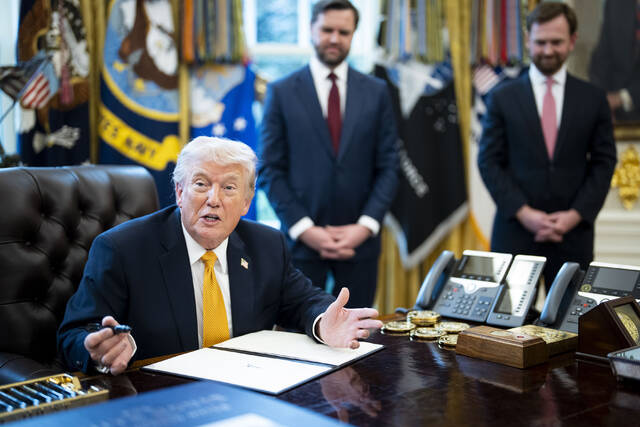
“I do believe I’ll be having the honor of taking Cuba,” President Donald Trump told reporters in the Oval Office on Monday.
“Taking Cuba in some form, yeah,” he added when a reporter asked for clarification. “Taking Cuba. I mean, whether I free it, take it — I think I could do anything I want with it, if you want to know the truth.”
Even by Trump’s precedent-shattering standards for speaking his mind as the U.S. president, his comments were a stunning insight into his perceptions of his power and its lack of limits.
There have been 13 U.S. presidents since Fidel Castro took power in Cuba, all with their own complicated and often contentious relationship with the Communist-ruled island. But none has so publicly pondered seizing control of the nation, until now. And after Trump’s military attacks in Venezuela and Iran this year, his comments may not simply be off-the-cuff musings.
Instead, the remarks seem to suggest that Trump is pushing toward a third consecutive attempt to behead a foreign government, perhaps before the year finishes its first quarter.
“I am holding Cuba,” he said Sunday aboard Air Force One, adding, “We will pretty soon make a deal or do whatever we have to do.” But he also made the sequencing clear: “We’re going to do Iran before Cuba.”
In reality, the Trump administration is already engaging on both. Since January, the U.S. has established what amounts to an oil blockade on Cuba, threatening other countries if they provide oil to the island and even taking military action. Last month, a U.S. Coast Guard vessel intercepted a tanker full of crude oil from Colombia en route to Cuba.
As a result, Cuba has not received any significant oil or fuel shipments since Jan. 9, creating a rapidly escalating crisis on the island. Gasoline sold on the black market has soared to about $35 a gallon and the electricity is failing almost every day, including a nationwide blackout Monday. Surgeries are being delayed, medicine is running out, and food insecurity is increasing.
That has backed Cuba’s leadership into a corner.
President Miguel Díaz-Canel delivered a national address last week that acknowledged for the first time that Cuba was talking to the United States and would soon begin opening its economy.
At the same time, the Trump administration was making clear to Cuba that Díaz-Canel must go, The New York Times reported Monday. So far, the White House is not pushing for action against the Castro family, which remains in power behind the scenes. That is in line with the Trump administration’s preference for regime compliance, versus regime change, as seen in Venezuela.
Russia has signaled it is prepared to back Cuba, its longtime ally, if necessary. A Kremlin spokesperson said Tuesday that Russian and Cuban officials were in close contact about the crisis.
On Monday night, Cuba’s economic czar, Oscar Pérez-Oliva Fraga, announced a series of changes to allow Cubans abroad to invest, bank and do business in Cuba, a potentially major shift in policy that the Cuban diaspora has long been seeking.
In one sign of the pressure that Cuba is under to make such changes, Pérez-Oliva Fraga made the announcement over the radio. He had been scheduled to speak on television, but the power grid — which runs largely on oil — was still out. By 7 a.m. local time Tuesday, the Cuban government said nearly 70% of Havana, the capital, was still without power.
The potential of an economic reopening of Cuba is not lost on Trump. A real estate mogul with a long interest in South Florida and the Caribbean, Trump has long coveted the island.
In 1998, a company he controlled secretly hired consultants to visit Cuba to explore its potential, a trip that might have violated the U.S. embargo on Cuba, according to a 2016 investigation by Newsweek. In 2011 and 2012, Trump Organization executives visited Cuba scouting for a golf course, Bloomberg reported in 2016.
While on the campaign trail in 2016, Trump repeatedly said he would like to do business there. “Cuba would be a good opportunity for investment,” he told a Miami news station that year. “I think probably the time’s not right.”
Now he is suggesting the timing might be near. “They’re talking to us. It’s a failed nation. They have no money. They have no oil. They have no nothing,” he said in the Oval Office on Monday.
Then he had another thought. “They have nice land. They have nice landscape,” he said, adding, “I think Cuba, in its own way, tourism and everything else, it’s a beautiful island, great weather.”
But then he revealed the geographical and meteorological limits to his knowledge. “They’re not in a hurricane zone, which is nice for a change, you know?” he said. That, of course, is like saying it doesn’t snow in Buffalo, N.Y.
Trump, however, already seemed to be thinking in the context of Cuba as U.S. property: “They won’t be asking us for money for hurricanes every week.”
Copyright ©2026— Trib Total Media, LLC (TribLIVE.com)