
Joint U.S.-Israeli attacks on Iran killed Ayatollah Ali Khamenei, the nation’s supreme leader for almost 37 years, the Iranian government said Sunday, raising the prospect of a power vacuum in an already turbulent region.
The Iranian state news agency confirmed the supreme leader’s death as another wave of U.S. and Israeli attacks hit the country. President Donald Trump had announced the death hours earlier, saying that heavy bombing in Iran would continue “uninterrupted throughout the week or, as long as necessary to achieve our objective of peace.”
The initial attack Saturday, which set off retaliatory strikes by Iran against Israel and U.S. interests in the Middle East, followed weeks of threats from Trump that the United States would strike Iran unless its leadership agreed to U.S. demands, especially over its nuclear program. U.S. and Iranian officials held a last-ditch round of mediated talks last week that ended without a breakthrough.
Why did the U.S. and Israel attack Iran?
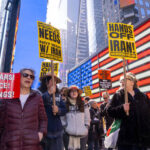
The latest tensions began in January, when Trump vowed to come to the aid of protesters when Iran’s government used lethal force to crush public unrest. In taped remarks announcing the attack Saturday morning, Trump urged Iranians to “take over your government” once the military action concluded.
“No president was willing to do what I am willing to do tonight,” he said. “Now you have a president who is giving you what you want, so let’s see how you respond.”
It is the second time in less than a year that the U.S. military has struck in Iran. Last June, U.S. forces bombed three nuclear facilities in the country. This time, U.S. officials said they expected a far more extensive assault.
For Prime Minister Benjamin Netanyahu of Israel, joining the strike on Iran was part of a long-held goal to overthrow the government in a country he had portrayed as an existential threat. In a televised statement, Netanyahu said the U.S.-Israeli attack could “create the conditions for the brave Iranian people to take their destiny into their own hands.”
What was targeted?
The attacks began Saturday, with reports of explosions across several Iranian cities, including Tehran, Qom, Kermanshah, Isfahan and Karaj, according to Iran’s semiofficial Fars News Agency.
HRANA, a Washington-based Iranian rights group, said late Saturday that at least 133 civilians had been killed and that 200 others were injured. The figures could not be independently confirmed.
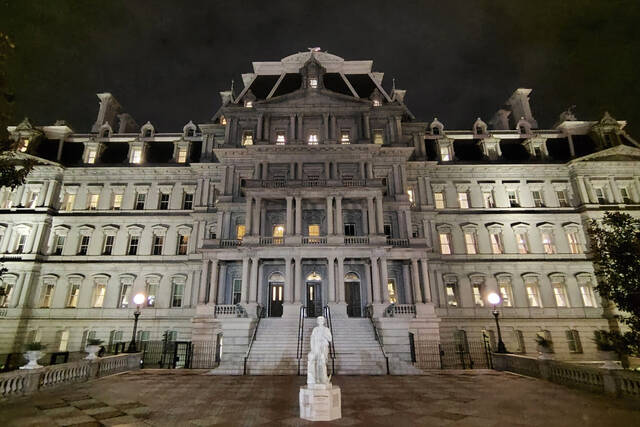
Israel’s military said that one of its initial targets was a gathering of senior Iranian officials. Videos verified by The New York Times showed strikes in an area of Tehran that houses the presidential palace and Iran’s National Security Council, among other important government buildings. Another video showed a strike near the Ministry of Intelligence.
Iran’s state news agency confirmed the deaths of two high-level military leaders: Rear Adm. Ali Shamkhani, secretary of the defense council, and Maj. Gen. Mohammad Pakpour, commander in chief of the Revolutionary Guard.
Khamenei was killed in his office at home in an attack early Saturday, according to Tasnim, Iran’s semiofficial state media. Satellite imagery showed a plume of black smoke and extensive damage at his secure compound.
U.S. officials said the military had carried out dozens of strikes, with attack planes launched from bases around the Middle East and from at least one aircraft carrier. The initial wave of U.S. attacks focused on military targets.
The Israeli military also said its air force had carried out a broad wave of strikes on multiple military targets in western Iran; aerial defense and missile launchers in central Iran; and a surface-to-surface missile launch site in the area of Tabriz, in eastern Iran. It said early Sunday that it had begun another “strike wave” targeting Iran’s ballistic missile array and aerial defense systems in the Middle East.
Israeli officials said they expected the assault to last several days.
How has Iran responded?
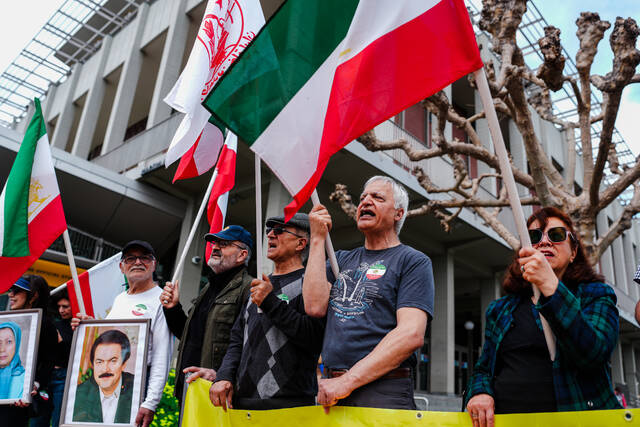
Iranian officials were defiant when announcing the death of Khamenei. On Iran’s state television, the anchor read a statement from the National Supreme Council saying his “martyrdom will spark a massive uprising in the fight against oppressors.”
The Revolutionary Guard said in a statement on Iranian state media that the supreme leader’s death would only make the nation more determined to continue in his path, and condemned the actions of the United States and Israel, vowing to punish their aggression.
In retaliation for the attacks, Iran fired a barrage of missiles and drones at Israel, the Revolutionary Guard said in a statement on Telegram. It also launched missile attacks targeting U.S. military bases in the region, including Al Udeid Air Base in Qatar, Ali Al Salem Air Base in Kuwait, Al Dhafra Air Base in the United Arab Emirates, and the U.S. 5th Fleet headquarters in Bahrain, Fars reported.
U.S. Central Command said that its forces “successfully defended against hundreds of Iranian missile and drone attacks” and that damage to U.S. bases in the region has been “minimal and has not impacted operations.”
Debris from intercepted missiles landed in a residential neighborhood in Abu Dhabi, the capital of the United Arab Emirates, killing one person and damaging property, the UAE Defense Ministry said, adding that it had successfully intercepted several missiles launched from Iran.
Qatar’s Ministry of Defense said that it had “successfully thwarted a number of attacks” targeting its territory. The attack echoed another strike last June, when Iran fired more than a dozen missiles at a U.S. military base near the Qatari capital, Doha, in response to a U.S. attack on its nuclear facilities.
The Persian Gulf States are home to a number of U.S. bases and embassies, and experts had warned that Iran would target them in retaliatory strikes. Before the strikes Saturday, the U.S. military had built up forces in the region in what Trump had described as an “armada.”
Iran also asked the U.N. Security Council to intervene, and it accused the United States and Israel of violating international law.
Is the United States at war with Iran?
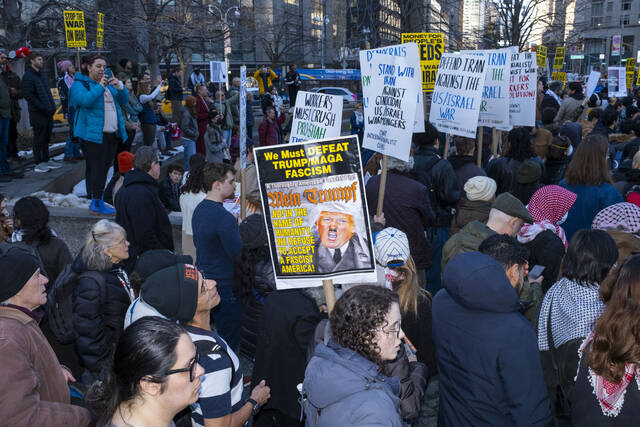
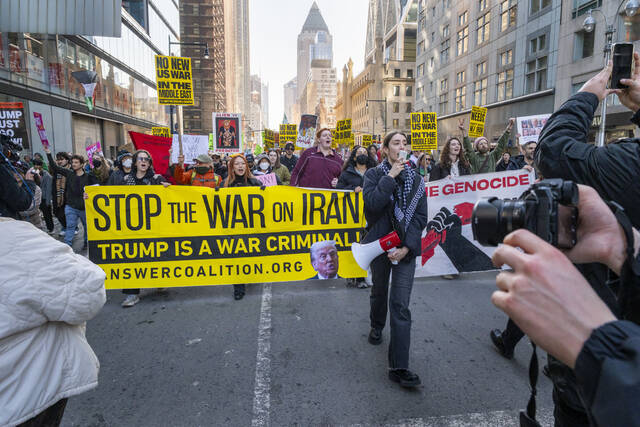
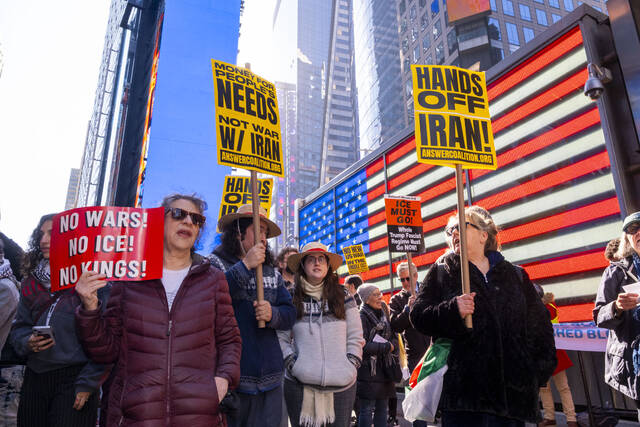
Trump’s unilateral decision to launch the attack has opened a new chapter in a recurring debate over who rightfully wields war powers in American democracy. The move has raised accusations that he is violating the Constitution by starting a war without congressional authorization. And it appears likely to prompt a belated debate this coming week in Congress under the War Powers Resolution.
Many Democrats and at least two Republicans in Congress are insisting that Congress must vote on whether the country enters such a conflict.
The accusations underscore a split that has emerged between how the founders intended American-style democracy to function and how it has frequently worked, especially during and since the Cold War.
What else might be affected?
The conflict has quickly threatened the flow of oil out of the Middle East, which could make gasoline and other fuels more expensive. Shipping companies have stopped sending their tankers through the Strait of Hormuz, the narrow passage through which at least 20% of daily oil production travels, according to oil industry analysts.
“Nobody’s going to enter right now,” said Angeliki Frangou, the CEO of Navios Maritime Partners, a Greek shipping company with vessels in the region, referring to the strait.