Public comment periods are meant to let people talk to the government. Sometimes it’s about actions that are happening or decisions that are pending. Sometimes it’s about bringing problems to the government’s attention.
A comment period is one mechanism municipalities, school boards and other agencies can use to make that process tick by with clockwork efficiency. It prescribes when a speaker can speak. It sets up the format. It establishes the time frame. It also moves the blame. It isn’t council’s fault you only get a few minutes to speak. It’s the policy.
That can work — until it doesn’t.
It can work because, as many municipalities can attest, not that many people attend most local government meetings. It can fall apart when a contentious issue suddenly brings in a crowd.
Ask Springdale.
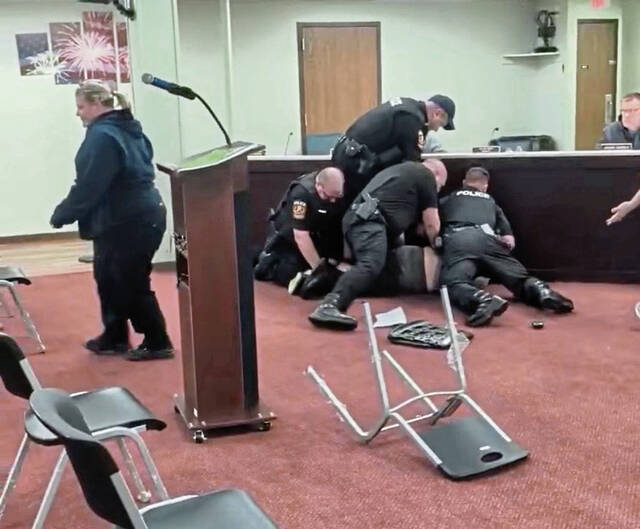
A borough council meeting last week ended with more than harsh words. What started with public comment from William Daniel “Danny” Rosenmund, 36, of Springdale didn’t stop at the prescribed three minutes. When he wouldn’t stop, officers tried to remove him from the meeting. Things escalated. Eventually, Rosenmund was pinned down by four officers, arrested and transported to the hospital. One officer went to the hospital with injuries. The chief of police was bitten.
What happened after that depends on who is telling the story. How it got there should concern everyone.
While video shows one alarming story of a meeting turned chaotic, Springdale officials push back. They say the context misrepresents a “professional and controlled effort.”
Perhaps the control is the problem.
Rigid rules around public comment periods can maintain discipline that provides fairness when many people are speaking. They can keep the process chugging along smoothly. They are permitted under the Pennsylvania Sunshine Act — and three minutes is a common limit.
But rules set in stone can place municipalities and residents between a rock and a hard place.
It sets up an adversarial relationship between the public and the government. That is not productive for anyone.
It can make the local government to look unyielding rather than organized. The people can feel muzzled rather than invited into public participation. It can be hard to hear what people are saying — or to feel heard — when someone is holding a stopwatch. A time limit can place the focus on cutting off speech instead of opening dialogue.
When the people feel like their voices are being muted, they shout louder. When government feels ignored, it does the same.
Rigidity provides structure. Without flexibility, it invites breakage where no one wins.
Someone needs to give in this staring contest, and it shouldn’t be the public. Municipalities such as Springdale must recognize the power they hold cannot just be wielded. It can also be tempered.
Because once a conversation ends in handcuffs, the handcuffs are all anyone remembers.