Snow days make you want to be out in the stinging wind, feeling the crunch of drifts under your boots, making angels on the lawn and building a fort to fight off your friends with a volley of solidly packed snowballs. It is the quintessential winter memory, the one adults want to relive and the one they want to share with their children.
But that memory has boundaries. And Pittsburgh’s rivers are not part of it.
A sheet of ice on a pond or a lake is tempting. If the temperature is low enough and the ice is thick enough, it may be the right time to strap on skates and live out some Olympic dreams. But that should not — cannot — happen on a river.
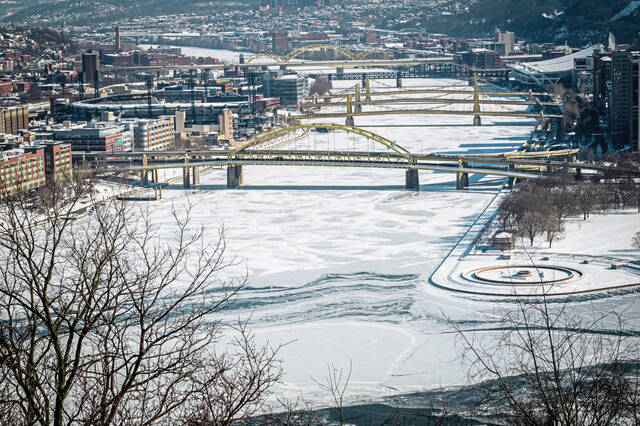
In recent days, as temperatures have turned Southwestern Pennsylvania into a deep freeze, the region’s rivers have seemed to play along. They look as though they have become vast rinks, waiting for cold-weather fun. The rivers lie.
The Allegheny, Monongahela and Ohio are not frozen solid, the same way your fingers really are not frozen inside your gloves, even if they feel stiff and unmoving.
But the more people pretend the rivers are sturdy, the more they seem that way.
Last week, a Pittsburgh man led police on a chase as he walked along the Allegheny River. It was not long before others were drawn to the icy surface, strolling in ways that are rarely possible.
The problem is simple: While lakes and ponds are still, rivers are not. The current continues to move beneath the surface, eroding ice from below, even when that ice appears thick.
The U.S. Coast Guard has reported ice as thick as 5 to 8 inches on Pittsburgh’s three rivers. That does not mean the ice is uniform. It does not mean there are not cracks. It definitely does not mean it is safe.
The dangers of a frozen river go beyond the thickness of the ice. They include the inability to see — or reach — someone once they fall through. A sheet of ice can conceal a person as the water beneath carries them downstream.
In a pond, rescuers can search near the break. In a river, they can’t.
And then there is the cold.
Just one day after the frozen police chase on the Allegheny, a woman died when her vehicle left the Parkway East and plunged into the icy Monongahela River.
It took three divers to recover her, their time in the water staggered to prevent hypothermia. Jacinta Stevens, 31, was resuscitated at the scene but later died at UPMC Presbyterian. Her SUV remains in the river; conditions were too dangerous to attempt recovery.
The most alarming images of people venturing onto frozen rivers are the ones that include children accompanied by adults who should know better.
Putting a child on a frozen river is not just irresponsible. It is dangerously foolhardy. In a world where we have passed laws and created products to protect children, this discards bike helmets, car seats and mandated reporting in favor of handing a child a fork and pointing it at an electrical outlet.
Adults have no business risking their own lives on a frozen river that authorities have warned against. Such recklessness also puts the lives of first responders at risk.
“Once you go through the ice, anything can happen,” said Jeff Stephens, chief of the Blawnox Swiftwater Team.
But when every backyard is a winter wonderland, there is no reason — none — to ever put a child in danger this way.