

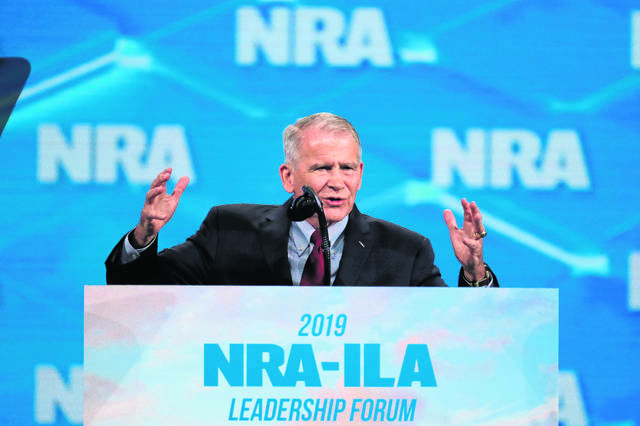
The National Rifle Association has big troubles. It’s wildly in debt. The attorney general of New York — where the NRA was founded in 1871 and where it remains incorporated — is investigating the tax-exempt status of what she has called a “terrorist organization.” The NRA’s longtime chief executive, Wayne LaPierre, is in a bitter feud with its outgoing president, Oliver North. Accusations are flying, including of attempted extortion and misuse of perhaps millions of dollars.
On the surface, the NRA’s problems have little to do with the typical criticisms hurled at it by its biggest detractors. To them, the villainous NRA is too rich, too powerful and too well-run, not an outfit drowning in red ink and dysfunction. But it turns out that its real problems, in part, may stem from its outsized ambitions.
For most of its history, the NRA was a sporting club dedicated to teaching gun safety and promoting hunting and marksmanship as a pastime. It was founded by two Union Army officers who had noticed that the Confederates tended to be better shots. In the 1930s, it started to dip its toes into lobbying, but in favor of limited gun control. The NRA, for instance, supported the Federal Firearms Act of 1938, which established federal gun licensing requirements. It wasn’t until the mid-1970s, after passage of the federal Gun Control Act, that new leadership at the NRA made lobbying for gun rights central to its mission.
Still, that mission was notably bipartisan. Working from the commonsense assumption that gun rights would be better protected if support came from both parties, the NRA once supported candidates on either side of the aisle. In the 2000 campaign cycle, it spent $372,000 on some 66 Democratic incumbents. But by 2016, it contributed to just four.
What happened? The easy answer is that the GOP increasingly embraced gun rights and the Democrats embraced gun control — or the other way around. Which side is guilty of policy extremism depends on your views on gun policy. Asking which side is guilty of rhetorical extremism is pointless, because both are. The NRA is not a “terrorist organization,” but neither are its opponents a horde of anarchists, socialists and goons, as the NRA’s media arm often portrays them.
The GOP-NRA alliance came downstream from two larger social shifts. The first is the “Big Sort” — shorthand for how American society has self-organized not just into “red” and “blue” regions, but also worldviews. The end of the NRA’s bipartisan lobbying strategy simply reflected the facts on the ground. In 1989, 64% of Republicans had a favorable view of the NRA, and so did 49% of Democrats. Today, those numbers are 88% and 24%, respectively.
The second reason is that the parties are weaker than they have ever been. The common assertion that Republican politicians are pro-gun because they’ve been bought off with NRA blood money is mostly a paranoid conspiracy theory. The NRA doesn’t actually give very much money to politicians, at least compared with, say, organized labor or trial lawyers.
What the NRA does do — incredibly effectively — is organize and inform voters, mobilizing them to vote reliably for philosophically aligned candidates. Historically, that was a function of political parties, but now it’s been largely outsourced to special-interest groups such as the NRA but also Planned Parenthood for the Democrats.
The net effect has been for these interest groups to go all in for the culture war — which is highly effective for fundraising — and take our elections with them.
Political parties once had the desire and resources to manage their own brands — keeping activists and interests at a more healthy distance. Those days are gone. Parties — and the institutions that really run them — are simply uniforms for combatants in the culture war. In such a climate, it’s no surprise that things such as good corporate governance became an afterthought at the NRA.