In 1992, the U.S. Department of Agriculture adopted a new way to look at what we eat. The food pyramid already had been in use for decades in Sweden, but now Americans were able to use the handy visual aid for prioritizing nutritional choices.
The idea was simple: Put the most important things at the base, build upward from there and be cautious about what ends up on top. It was a reminder that structure matters — that what you emphasize, and what you minimize, shapes outcomes.
Journalism works much the same way — in reverse.
I’m going to be honest here. I’m not really a fan of the inverted pyramid style. It harkens back to a time when information had to be top-loaded so, if you ran out of paper or ink, readers still knew what they needed to know.
In a digital world, the inverted pyramid can work against you. It feeds skimmers data without context. It gives you dessert without dinner.
Robert F. Kennedy Jr. has inverted another pyramid. On Jan. 7, he unveiled revised federal dietary guidance that elevated meat and dairy while pushing whole grains — once the model’s broad foundation — to a tiny corner at the bottom.
It is not the only table he has flipped. In the last year, Kennedy has spent his time steering America away from vaccines and longstanding medical consensus, deprioritizing research and embracing fringe theories.
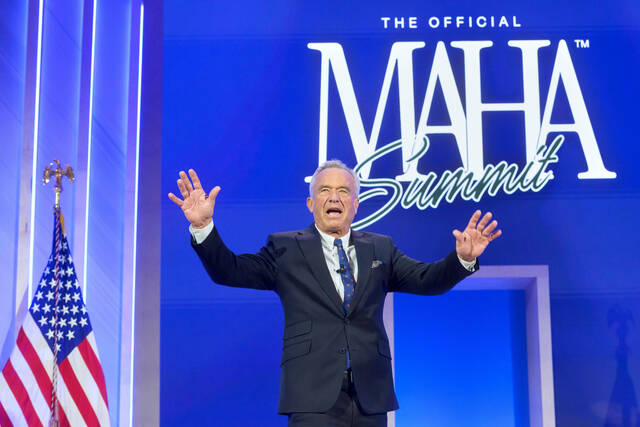
On Wednesday, he was in Harrisburg as part of a rally-style tour promoting his “Make America Healthy Again” campaign. Pennsylvania is a logical stop — a major agricultural state with a large footprint in food production.
He might want to think about that a bit more. Pennsylvania produces plenty of potato chips and chocolate bars — foods that fare poorly on his new pyramid and, to be fair, on the old one, as well.
What made the Harrisburg stop telling was not the talking points but the audience. Many of the most enthusiastic attendees were not there to debate dietary guidance but because they had followed Kennedy through anti-vaccine networks. Protesters outside focused not on food but on immunization policy and research cuts.
Kennedy’s ideas clearly have corners of passionate support. But science and medicine are not places to play to the crowd. They are spheres where belief and knowledge are very different things — and the difference matters.
But perhaps the secretary should spend less time thinking about the orientation of a pyramid and more time worrying about the point of a needle. We are barely three weeks into 2026, and there have already been 171 confirmed cases of measles this year — according to his own Centers for Disease Control and Prevention.
In 2016, there were just 86 cases for the entire year.
This is not the kind of inversion we need.
The point of Kennedy’s job is to improve the health of the nation. After a year, and with a disease once thought contained surging so dramatically, it is hard to argue he has injected much health into the nation’s human services.