
https://triblive.com/opinion/lori-falce-constitution-under-construction-2nd-amendment-a-study-in-balance/
Lori Falce: Constitution Under Construction: 2nd Amendment a study in balance

Editor’s note: This is the third column in a series exploring the history and legacy of amendments to the U.S. Constitution.
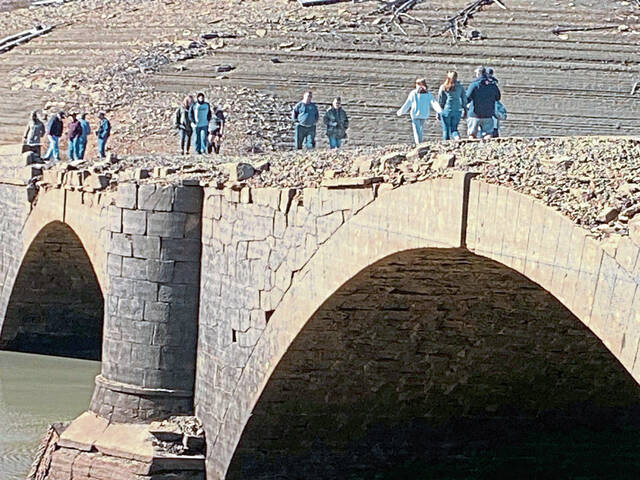
In architecture, a keystone is the wedge-shaped stone set at the top of an arch. It is placed last. The stones on either side lean inward, pressing against it. The keystone does not eliminate tension; it absorbs it. Without that center stone, the arch collapses. Without the opposing pressure on either side, it cannot stand.
Stone doesn’t bend. To build the curve at the top of an arch — to bring solid rock from each side together into a structure that gains strength from pressure — there must be a specially designed piece to lock them in place. That is the keystone.
The Second Amendment is an arch built of solid ideas that press against each other, creating a tension that has endured for centuries.
“A well regulated Militia, being necessary to the security of a free State, the right of the people to keep and bear Arms, shall not be infringed.”
It is an odd sentence in multiple ways. It is constructed of four clauses that do not sit easily together, with commas that feel misplaced. But its grammatical awkwardness is nothing compared to the pull between its ideas.
The amendment begins with a limit on power and ends with a limit on government. That polarity makes it controversial today. It was not a unanimous position in 1787, either.
Gerald Dickinson, dean of the University of Pittsburgh School of Law, identifies another strain — that between the text and the context.
The language did not emerge in isolation. Colonists had just fought a war in which professional soldiers answered to a distant crown. They valued the ability to defend themselves and distrusted standing armies that operated beyond local control.
Constitution Under Construction
• Who’s on First? • Built for change
That sentiment found explicit expression in Article XIII of the Pennsylvania Declaration of Rights of 1776, which declared:
“That the people have a right to bear arms for the defense of themselves and the state; and as standing armies in the time of peace are dangerous to liberty, they ought not to be kept up; and that the military should be kept under strict subordination to, and governed by, the civil power.”
The final language was not what was originally proposed. James Madison’s first draft leaned more heavily on militia and common defense and included a clause protecting those “religiously scrupulous of bearing arms.”
How did that language become the final text? Through negotiation and compromise — and not without difficulty.
“None of (the delegates) could get along, and all of a sudden, you threw them all into this, you know, hot, sticky, warm room in summer … and they somehow were able to figure it out,” Dickinson said. “It was a miracle.”
Today, compromise is harder to find. Debate often hardens into camps arguing over text, intent and interpretation.
Dickinson sends readers back to the original words and the history to dig into questions of what “well regulated militia” means and how it balances with “the right of the people to keep and bear Arms.” But when it comes to judicial interpretation, the record is thinner.
“The Second Amendment doesn’t have much in terms of case law. We oftentimes will look to precedent. What has the Supreme Court said in the past on this question?” Dickinson said. “Up until 2008 — the Heller decision — the Supreme Court did not say much. … There were not many cases, and so there wasn’t a whole lot for the Supreme Court to rely upon.”
In the landmark District of Columbia v. Heller decision, Justice Antonin Scalia, an originalist, wrote the majority opinion. The Court parsed the amendment as protecting an individual right rather than a collective responsibility tied to militia service. By the narrowest margin, it struck down Washington, D.C.’s handgun ban.
The individual and the collective function as counterweights within the same sentence — the balance depends on how the language is read. Heller represented the Court’s first major shift in emphasis. The words did not change. The reading did.
The Second Amendment is now among the most hotly debated of the Bill of Rights. That heat does not make change impossible. The Constitution is built for change, and the right to bear arms was itself one of the earliest amendments.
Dickinson suggests that future change is more likely to come from the bench than from Congress.
“Sometimes the United States Supreme Court interprets the Constitution … in a way that really alters the meaning, as if Congress or the states had gone in and actually changed the text,” he said. “Maybe they go back to well-regulated militia. That could happen.”
“I think we can better come to the table with our different opinions and find a way forward. And that, in many ways, is what our Founding Fathers did during that very, very hot summer of (1787),” Dickinson said.
A shift to one side or the other alters the distribution of weight. A keystone must be precisely set to hold opposing force in balance.
The balance is the design.
Copyright ©2026— Trib Total Media, LLC (TribLIVE.com)