When high school seniors across the city return to class from their spring breaks, the countdowns will begin. Only 50 school days left. Three more Monday alarm clocks. Two more final bells.
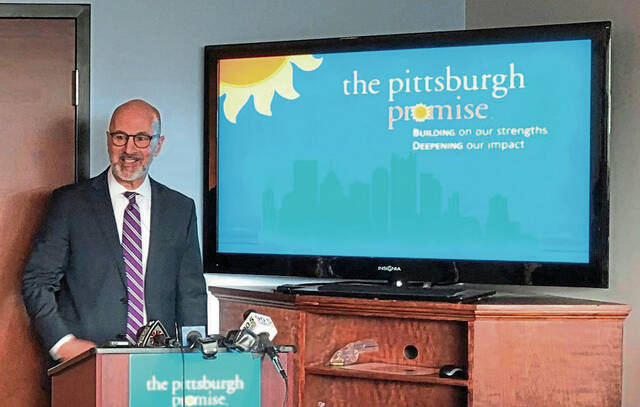
Unfortunately, there’s a more dismal countdown underway. The 2026 class will be the third-to-last group of Pittsburgh Public Schools graduates to receive college tuition support from the Pittsburgh Promise. Next spring, it’ll be the penultimate episode. The 2028 class will be the finale … then what?
This exact question was posed in an op-ed last year by Orli Trumbull, then a junior at Obama Academy. The title of Trumbull’s superb piece captured the worry of every parent and student in the city: “The Pittsburgh Promise is ending. What’s next?”
Writing with the kind of researched conviction that would make any teacher proud, Trumbull advised local leaders to “turn to other college readiness initiatives” in order to replace the Pittsburgh Promise, the storied privately funded college affordability program that had recently announced its funding streams would run dry in 2028. To Trumbull, 20 years of the Promise proved “that young people want to achieve greatness, and the community wants to support these students.”
Trumbull correctly diagnosed that the sunsetting of the Pittsburgh Promise signaled a massive shift in our civic history, one that needed to be reckoned with. “It is imperative,” she wrote, “that the city of Pittsburgh carries on its legacy.”
Enter the Pennsylvania Promise
Fortunately for Trumbull and for every Pittsburgh family wondering “what’s next,” there is another college readiness initiative that can carry on the legacy of the Pittsburgh Promise. It would barely require a rebrand.
The scholarship program is called the Pennsylvania Promise. The program would cover tuition at our community colleges as well as the state-owned universities for families making less than $250,000. Qualifying families could also apply the state-owned tuition rate at a “state-related” university (so, get the $7,994 covered at Slippery Rock, IUP or Penn West, or apply that same amount toward Pitt or Penn State’s tuition). Crucially, Pennsylvania residents 24 and older would qualify for adult-learner grants, helping them upskill and address what Pittsburgh Promise executive director Saleem Ghubril has estimated to be a 770,000 skilled-worker shortfall across the state by 2035.
Polling reveals widespread, bipartisan support for this sort of program. In a 2025 poll, 87% of Democrats, 62% of independents and 55% of Republicans said they would support the Pennsylvania Promise.
If that kind of bipartisan zeal for higher education funding sounds too good to be true, consider the red states where promise programs have been thriving. Nebraska and Oklahoma offer significant, enduring statewide tuition programs. The Tennessee Promise applies only to community colleges, the Texas programs are more fragmented as opposed to statewide, but both states are far ahead of Pennsylvania, which regularly ranks in the bottom 10 for higher education funding while often earning a top-five distinction for student debt.
The more immediate concern is our regional ranking.
Maryland, Delaware, and West Virginia offer community college promise programs. In New York and New Jersey, the programs expand to include tuition at four-year public universities. Without a program like the Pennsylvania Promise, our state’s best hope for keeping students and families in-state would seem to be: hope they’re too preoccupied saving up tuition money at multiple jobs to notice the opportunities across every state line.
Only three more graduating classes will be eligible for the Pittsburgh Promise. Young Pittsburgers like Orli Trumbull are asking us to carry forth its legacy, yet the local financial landscape is dire, what with the recent announcement of a significant budget shortfall. A broader coalition across Pennsylvania is clearly needed, and while last year’s $5,000 Grow PA scholarship distributed funds to nearly 5,700 students statewide, that well-intentioned effort is simply not enough to help the state train and credential 770,000 workers by 2035.
We’re also surrounded by states that, policy-wise, are better positioned for a national climate in which the word of the year is “affordability.”
And yet: We have the Pennsylvania Promise legislation, which has been vetted and revised for years — long before affordability became a buzzword. It’s time for Pennsylvania residents to not only learn about the Pennsylvania Promise but to ask neighbors, business leaders, and legislators where they stand on it. It’s time to aid students who, while attempting to work their way through college, are instead participating in an unsustainable mutation of that noble practice, taking on full-time school, full-time employment, and crushing debt.
For Pittsburghers specifically, it’s imperative to recognize that 1) the story of our city cannot be told without the Pittsburgh Promise; and 2) the next chapter needs to be written. Now. The countdown is on.
Patrick McGinty is a novelist who teaches at Slippery Rock University and serves on the executive council of his statewide faculty union, APSCUF.