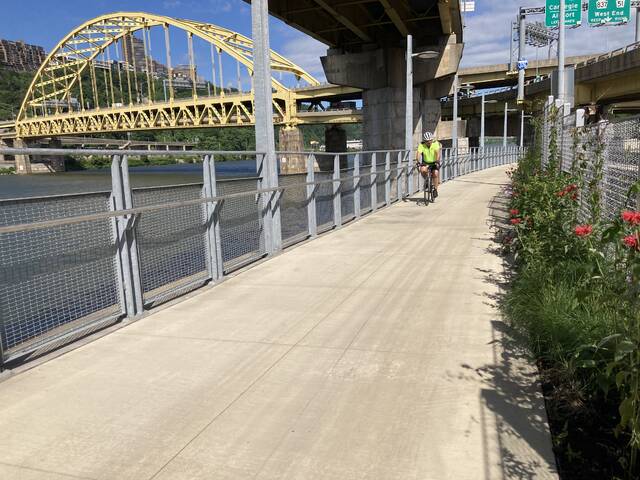
Trails and roads intersect in several ways, but from a transportation perspective they provide the same function.
In many ways, trails are more accessible to a greater number of Pennsylvanians. Trails are beloved as a safe and comfortable place to move, to see, smell and experience the out-of-doors; to interact with family and friends; and for commuting or commerce. Sadly, in our auto-dominated culture, sidewalks are nonexistent in many places, and the lethal potential of large vehicles traveling at high speeds makes walking and cycling on most roads unsafe.
Trails relieve this unmet demand for walkability and bikeability. If properly planned, trails can provide access to schools, workplaces, stores, main streets and parks. Their value is hugely increased because of connections to the places people need to go.
Safe Routes to School (SRTS) is a federally funded program now embraced in the transportation sector — a step in the right direction.
The funding paradigm for trails is shifting. Historically, trails have been considered a “nice-to-have” community asset. Consequently, funding was periodic and grant-based, and more affluent communities were favored for funding because they had the ability to dedicate additional resources to trail planning, design, construction and maintenance. Meanwhile, communities where trails are a “need-to-have” alternative to buying and maintaining a car are effectively boxed out by a grant-based funding approach that requires a funding match and local initiative from already strained and stressed communities.
Reflecting an outdated view of how trails are used, federal transportation funds have designated less than 1% for a mix of transportation “related” infrastructure initiatives. Today, that sliver is called Transportation Alternatives Set Aside. In Pennsylvania, where the attitude toward trails has been evolving in the right direction since the covid-19 pandemic, which prompted an explosion in use, some additional sources of transportation funding have been tapped.
The Pennsylvania Environmental Council (PEC) has been at the forefront of this shift. In the Philadelphia area, PEC rallied elected leaders from Bucks, Chester, Delaware, Montgomery, and Philadelphia counties to identify new and expanded federal funding for the Circuit Trails network. In July, $120 million of Carbon Reduction Program (CRP) funding was committed to build Circuit Trails. This is unprecedented both in Pennsylvania and nationwide.
CRP was established in the recently adopted Bipartisan Infrastructure Law (BIL), also known as the Infrastructure Investment and Jobs Act (IIJA), in order to reduce carbon emissions within the transportation sector. Trails are explicitly eligible, and local leaders have seized the opportunity because, in the Philadelphia area, trails are wildly popular. Clear patterns of increased use on some trails show that literally millions of bicycle commuters are using the trails for work trips — music to the ears of local officials dealing with rush-hour congestion.
All this is to say that the state of Pennsylvania and local communities can fund trails more reliably through transportation sources, and these approaches can be normalized across the commonwealth. All that’s required of transportation planning organizations is some planning and a commitment to include important trails in their long-range transportation plans. We promoted the inclusion of critical trail corridors in the Philadelphia region’s plan more than a decade ago, and we’ve been consistently advocating for more dedicated funding.
This funding approach needs to be better understood and implemented across the commonwealth. In light of their many environmental, health, and social benefits — especially for disadvantaged communities — it’s time we recognize that trails are truly “need-to-have” transportation infrastructure.
Patrick Starr is vice president of the Pennsylvania Environmental Council.