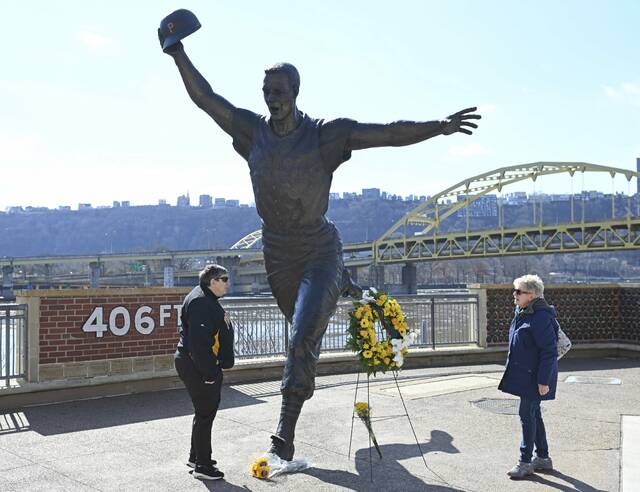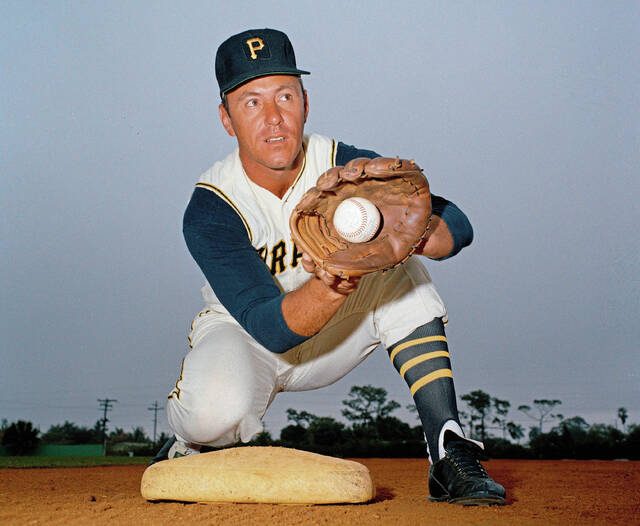
Whether it was fate, divine intervention by the baseball gods, or just a player seizing the moment, Bill Mazeroski was a peculiar source for having propelled the Pittsburgh Pirates to victory in the 1960 World Series.
On Oct. 13, 1960, when Mazeroski clubbed Ralph Terry’s second pitch over the left field wall at Forbes Field to lift the Pirates to a 10-9 Game 7 win over the New York Yankees, a spotlight was forever fixed on a thoroughly unpretentious man better known on the baseball diamond for stellar defense than a powerful bat.
Mazeroski’s passing at age of 89 on Friday triggered an avalanche of tributes and fond remembrances in Pittsburgh and across baseball, honoring the architect of one of the most unforgettable moments in baseball history.
In a recent conversation with TribLive, John Thorn, official historian of Major League Baseball, offered insight into the Hall-of-Fame career of Mazeroski, his prowess at second base and the 1960 World Series, 66 years later.
Maz’s Hall of Fame case
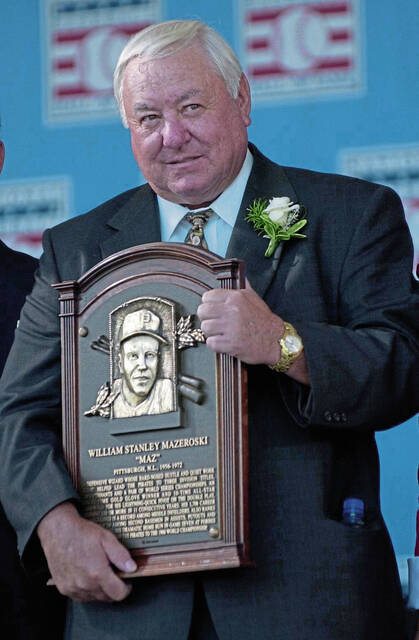
Mazeroski was inducted into the National Baseball Hall of Fame in 2001 via the Veterans Committee.
For Thorn, Mazeroski’s enshrinement, which came 29 years after his career (1956-72, all with the Pirates) wrapped, was proper.
“I think the legacy of casual fans will be the home run and people will tend to disregard 17 years of defensive wizardry,” Thorn said. “It’s easy to look at the Hall of Fame and think, ‘Well, if you’re going to rip plaques off the wall, Mazeroski is among the first to go.’ But he got in deservedly as far as I’m concerned.”
Detractors have and will continue to point to Mazeroski’s middling offensive numbers, namely a .260 lifetime batting average and .299 on-base percentage over 2,163 career games, in which he accrued 2,016 hits, 138 home runs and 853 RBIs.
But Mazeroski won eight Gold Gloves at second base (1958, 1960, 1961, 1963-67), was a 10-time All-Star and is MLB’s all-time leader in double plays turned at the position (1,706).
Additional metrics further shine a light on Mazeroski’s defensive impact on the game.
Since 1953, Mazeroski has been baseball’s leader in Total Zone Runs at second base (148).
A statistic that goes beyond fielding percentage, Total Zone Runs uses historical play-by-play data to gauge players’ defensive ability, with a single-season score of zero constituting league averages.
“It’s the double plays, it’s the fielding percentage, it’s the range factor — even in the Sabermetric era, if you look at defensive runs saved or total zone rating, Mazeroski is unparalleled,” Thorn said.
Defensive inductees
As Thorn pointed out, Mazeroski isn’t alone in having made it to the Hall of Fame mainly with a defensive resume.
“The reason that Mazeroski got in was because of the glove,” Thorn said. “He was unparalleled among second basemen. If anything, he stands in tradition of shortstops and catchers who have made it into the Hall of Fame primarily because of defense.
“Rabbit Maranville (inducted in 1954), Joe Tinker (1946) and Bobby Wallace (1953) got in because of their gloves.”
Wallace, who owned a career .268 batting average, played from 1894-1918 and was a contemporary at shortstop of Honus Wagner, as was Tinker, who batted .262 from 1902-16.
Maranville, another shortstop, hit .258 in a playing career that lasted from 1912-35.
For a more recent example, Thorn pointed to Andruw Jones, a Class of 2026 inductee who batted .254 with 1,933 hits over 17 big-league seasons.
Granted, Jones hit 434 homers and was a five-time All-Star, but won 10 straight Gold Gloves from 1998-2007.
“Andruw Jones is in because of his glove in center field, not because of his batting stats,” Thorn said.
With a brief thought, Thorn summarized why elite defensive ability, often viewed less attractively in Hall of Fame consideration than sustained offensive production, is equally worthy in Hall of Fame discussions.
“A run saved counts no less than a run batted in,” he said.
1960 World Series revisited
The Pirates’ victory in the 1960 World Series and Mazeroski’s dramatic Game 7 home run unsurprisingly remain cherished parts of Pittsburgh sports and cultural history.
But 66 years later, Mazeroski’s homer has also cast elements of the series into relative obscurity.
Take for example, the roster composition of the two teams that met in that World Series and the popular recognition that the Pirates pulled off a stunning upset over the Yankees.
To be sure, the Pirates falling 16-3 in Game 2, 10-0 in Game 3 and 12-0 in Game 6 (their three losses during the series), was suggestive of the Yankees totally overwhelming their foe before Mazeroski’s home run flipped the script.
In contrast, the Pirates’ four victories, including the decisive Game 7, came by an average of 1.75 runs.
“The Yankees out-performed the Pirates in the World Series in their victories,” Thorn said. “When the Pirates won, the victories were narrow. … The slaughtering of the Pirates in the three games the Yankees won certainly makes you think that the two teams were wildly different in talent.
“Fifty-five to 27 is the number that sticks in my mind, the run-scoring differential between the two clubs.”
Offensively, the 1960 Pirates had a WAR of 32.1, compared to the Yankees’ 34.9.
Pirates pitchers combined for a 16.7 WAR vs. only 4.5 for New York.
The Pirates’ team batting average was .276, while New York hit .260 that season. Pittsburgh’s pitchers combined for a team ERA of 3.49, compared to the Yankees’ 3.52.
Both clubs boasted MVPs in the 1960 Fall Classic, in Pirates shortstop Dick Groat and Yankees outfielder Roger Maris, while the Pirates’ Vernon Law won the Cy Young, then awarded to the top pitcher in both leagues.
Pirates third baseman Don Hoak was also the NL MVP runner-up, as was New York’s Mickey Mantle for the AL. Eight All-Stars appeared on the Pirates’ roster in 1960, compared to seven for the Yankees.
“Coming into the World Series, it seemed that the Pirates were underdogs,” Thorn said. “But the Yankees were not dominant. They were a fading club of the 1950s and, in fact, they had not won the American League pennant the previous year. So coming into the Series, it might have been thought to be a better match for the Pirates than it turned out to be.”
For the remainder of his playing days and later in life, Mazeroski was humble about his World Series-winning home run, the only instance in MLB history where a Game 7 of the Fall Classic has ended via a walk-off blast.
But unquestionably, it relegated countless other moments in the Series and its final game within fans’ collective memories.
Perhaps no greater an example was Hal Smith’s eighth-inning, three-run homer that capped a five-run bottom-of-the-eighth for the Pirates, who took a 9-7 lead into the top of the ninth before New York tied things against Harvey Haddix, who replaced Bob Friend in the frame.
“It does tend to overshadow the Hal Smith home run, the Bill Virdon grounder (also in the eighth inning) that smacked Tony Kubek in the throat, great relief pitching that held the Yankees in check — there were so many aspects to that game,” Thorn said. “It’s easy to focus on the final inning and disregard all that had come before.”
Maz’s legacy secured
The Hall-of-Fame placement of Mazeroski, defensive credentials and his career-defining home run aside, will continue to spark debate in baseball circles.
As FanGraphs recently noted, to date, Mazeroski is the only player in the Hall of Fame with a sub-.300 on-base percentage.
Mazeroski, in his induction speech, did not shy away from noting his resume was defensive-centric, but called for equal consideration of those skills along with hitting and pitching.
Of that, or Mazeroski’s worthiness among baseball’s greatest players, Thorn needs no convincing.
“The idea that Mazeroski is in because of the single accomplishment, that being the Game 7, ninth-inning home run that won the (World) Series unexpectedly for Pittsburgh is a canard,” Thorn said. “It’s false.”