The Pittsburgh Penguins’ ownership transition from Fenway Sports Group to the Chicago-based Hoffmann Family of Companies could be tricky. (Like any transfer of a business worth over a billion dollars.)
But one thing is certain: Mario Lemieux will not ride in on a white horse to save the Penguins.
Hasn’t he done that enough?
Does the franchise really need saving?
If Lemieux wanted to run the Penguins, he’d still own the Penguins. His 22-year stewardship was always meant to be temporary. He and co-owner Ron Burkle tried to sell the team four times prior to FSG’s purchase.
Lemieux did what was best for the franchise and city as long as was necessary.
But now it’s not.
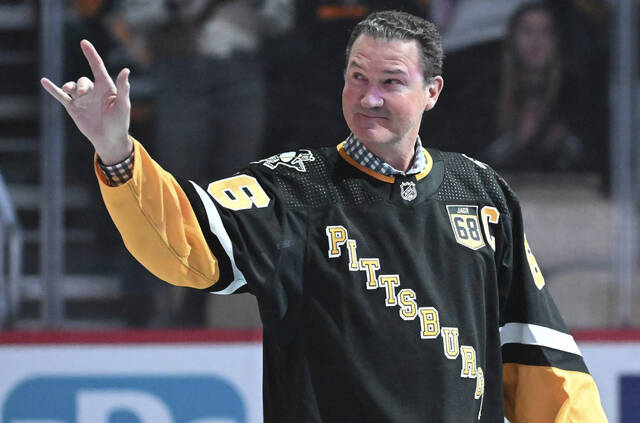
Lemieux is Pittsburgh’s biggest sports figure ever. He did the most. He was a unique owner. His tenure can’t be replicated. Lemieux presided over a golden era. Won three Stanley Cups. Got a new arena.
But let it go.
Lemieux was never the shadow GM. His keen hockey mind provided a sounding board. He was, for example, a big influence on the 2008 deal that acquired winger Marian Hossa and propelled the Penguins to that year’s Stanley Cup Final. But mostly, Lemieux hired and trusted the right people.
There seems to be a fantasy that Lemieux shows up at the sale’s closing, takes over as de facto GM and eagerly promises, “We’re going to win again right now!”
Then the Penguins do.
But the current seven-game losing streak points to the unlikelihood of that.
FSG mangled the team’s relationship with Lemieux.
That absolutely must be repaired by the Hoffman people, putting Lemieux in whatever role he wants. (Which figures to be peripheral at his behest.) He’s the face of the franchise, of Pittsburgh hockey. If you reconnect with Lemieux, the connection to the fan base strengthens. It’s what’s right.
But you won’t win quicker. Not unless he plays.
FSG is an excellent, professional sports ownership group. The Hoffmanns are rookies, except for owning an ECHL team.
That has no bearing. This is Pittsburgh, not Wheeling.
The sale price was a bit north of $1.7 billion. The deal stalled a few weeks back, reportedly because the Hoffmanns were under-capitalized. Not enough liquid. That’s a bit worrisome.
What is their intent? They seem to be hockey fans.
But we never knew Bob Nutting would be Bob Nutting until it was too late to keep him from being Bob Nutting.
FSG never embraced the NHL, and understandably so. FSG correctly saw the league as being a low-rent outfit with no vision. A garage league, as it’s been said.
But FSG never got Pittsburgh. Never connected.
They have deep pockets, are willing to spend, know how to win. But they never had an executive based in Pittsburgh. No boots on the ground. Always absentee.
That rates as one of FSG’s big mistakes with the Penguins, along with:
• Alienating Lemieux.
• Slowing a needed a rebuild by extending Kris Letang and Evgeni Malkin in 2022. (Which the citizens wanted, so FSG erred on your behalf.)
• Giving Mike Sullivan a three-year extension in 2022 when his coaching tenure had clearly stalled.
The Penguins are about $17 million under the NHL’s salary cap. That’s OK. When you’re rebuilding, there’s no point in cluttering your roster and sacrificing cap flexibility with a bunch of meh veterans. (The Penguins already have plenty of those.)
NHL players can’t reach unrestricted free agency till they’re 27 or have accrued seven full seasons. You can top off via free agency but can’t rebuild.
That’s where my worries about the Hoffmanns come in.
I hope they want to win, but I hope they know it won’t happen right away. I hope they don’t want to accelerate the rebuilding plan put in place by president of hockey operations/GM Kyle Dubas. It’s working. Let it happen organically.
Maybe Sidney Crosby will get a chance to win again in Pittsburgh. Maybe he won’t. But worrying about that only disrupts the process. Will Crosby’s management get the new owners thinking otherwise?
Even now, the Penguins have their priorities skewed. A promising beginning put a whiff of playoff possibilities in their nostrils, and now coach Dan Muse relies too much on below-the-line veterans, isn’t using kids in high-leverage situations and seems overly concerned with scratching out a No. 8 playoff seed at the expense of executing what was preconceived. That good start was just fool’s gold.
But that’s another column.