
https://triblive.com/sports/mark-madden-surprising-developments-have-kept-penguins-in-the-hunt/
Mark Madden: Surprising developments have kept Penguins in the hunt

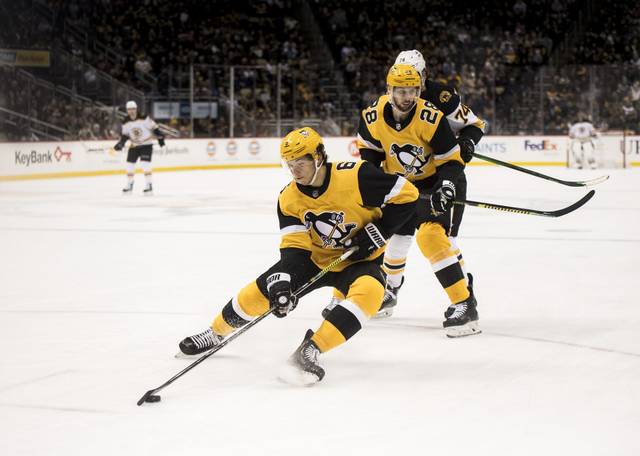
The Pittsburgh Penguins are as fast as they were in their Stanley Cup-winning years of 2016 and ’17.
GM Jim Rutherford saw to that by trading for Jared McCann and John Marino, signing Brandon Tanev and promoting Teddy Blueger from the minors. That was by design.
But the Penguins have developed in other important ways over their first 50 games. Those have transpired somewhat more organically.
Marino is a legit top-four defenseman in his first pro year. After an inconsistent first season in Pittsburgh, Jack Johnson has resurrected his game and played respectably.
Justin Schultz will return from injury soon, Brian Dumoulin in several weeks. When the Penguins’ best six defensemen are available, that group will be the team’s strength — aside from center, of course. It’s a mobile, skilled, versatile corps of blue-liners.
The organic part is the team’s structure and style, made possible by the departure of Phil Kessel. The current method was always the intent of coach Mike Sullivan, but execution is made possible by everyone being on the same page. Odd-man breaks have been slashed exponentially. Mistakes made pinching are minimal. The forecheck is relentless.
The Penguins’ record of 31-14-5 would be impressive even if they hadn’t conquered a biblical plague of injuries in its compilation. The Penguins have allowed the seventh-fewest goals in the NHL (136) and the eighth-fewest shots (1,492).
There have been a few surprise factors, to be sure:
• Bryan Rust has 21 goals in 36 games. His previous career high was 18. Roll over, Mike Bossy, and tell Rocket Richard the news.
• The line of Blueger, Tanev and Zach Aston-Reese is fast, relentless, tough to play against and gives Sullivan a trio that can legit match up against the foe’s top line. The Blueger line did well this past Sunday when used against Boston’s Patrice Bergeron, Brad Marchand and David Pastrnak, widely considered the NHL’s best line.
• Tristan Jarry played two NHL games last season. Now, he leads the league in save percentage and ranks second in both goals-against average and shutouts.
Rust’s scoring could hit a wall. Jarry’s performance has flattened over the last three weeks. The Blueger line seems unlikely to slow. Can Marino keep it up? He never played more than 35 games in a season during his three years of college hockey at Harvard.
But the Penguins are so diverse and so structured that any one or two strengths going off the boil temporarily wouldn’t cripple them.
Crosby was red-hot upon returning from the injured list. Malkin is playing the best 200-foot hockey of his career. (He still shouldn’t lead the team in penalty minutes.)
The power play is 17th in the NHL with a conversion percentage of 19.6. The penalty-kill stands 11th at 82.1 percent. Those need to be better — at least top 10.
With the NHL trade deadline a month away, Rutherford still must decide how to improve the Penguins and what to give up in the pursuit.
The Penguins clearly miss the injured Jake Guentzel, though to what degree isn’t yet clear. No rental winger seems worth the first-round draft pick required to get him. Perhaps Rutherford could give up less to get a competent third-line center and leave McCann on Crosby’s wing. But Rutherford likely will make a move with a flourish.
But right now, despite all the injuries, the Penguins have to be overjoyed about where they’re at and thrilled by the prospect of where they could be headed.
Washington, as always, remains a potential problem. The Capitals are fast and skilled like the Penguins but also play big. The Penguins can’t close that gap enough.
Copyright ©2026— Trib Total Media, LLC (TribLIVE.com)