By hiring Army’s former longtime offensive coordinator, are Pat Narduzzi and Kade Bell planning to implement the triple option at Pitt in 2026?
Not exactly.
But if they ever change their minds, Brent Davis would be happy to run them through the basics of the flexbone.
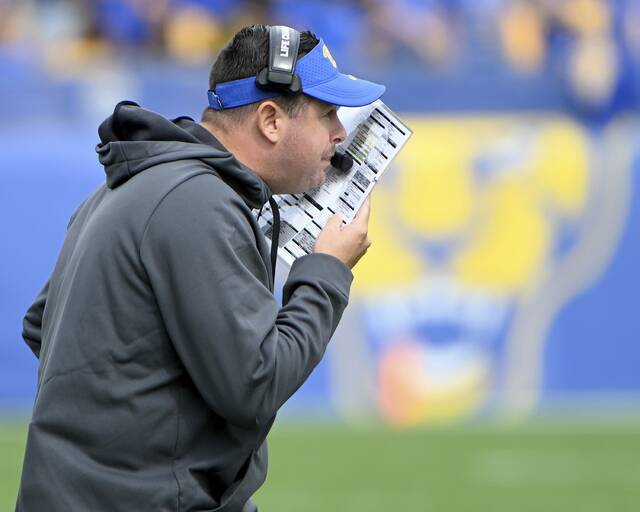
Davis, Army’s play-caller from 2014-22, joined Pitt as tight ends coach after spending the past three years on staff at Virginia Tech, where he worked first as an analyst, then co-offensive line coach and finally with the tight ends.
“Some people think you’re coaching a different sport when you’re coaching that style of offense, to be honest with you,” Davis said of his Army days. “But you find out that you’re not. Really, it’s about creating matchups, creating numbers advantages, creating angles, reading people to where you don’t have to block people at the point of attack and then when people make it unfair by rolling coverages and blitzing, having answers.
“It’s the same. It really is. (At Army), we were under center. (At Pitt), we’re 5 yards back. But a lot of the principles are the same. A lot of the blocking schemes are the same.”
Before Army, Davis also served as offensive coordinator at Georgia Southern (2010-13) and Virginia Military Institute (2006-09).
Davis had two stints at Georgia Southern, including a nine-year run from 1997-2005, where he spent time overseeing the offensive line and running backs.
One career highlight with the then-FCS Eagles was in 2011, when utilizing the triple option, they ran for 302 yards against No. 3 Alabama in a 45-21 defeat, which inspired a legendary rant by Nick Saban, who randomly brought the game up years later.
“I was a coordinator for 17 years consecutively, which hopefully gives me a good overall perception of how defenses work,” Davis said. “Maybe that’s a skill set I have that may be a little different from other tight ends coaches. I’ve coached every position on offense throughout my career.”
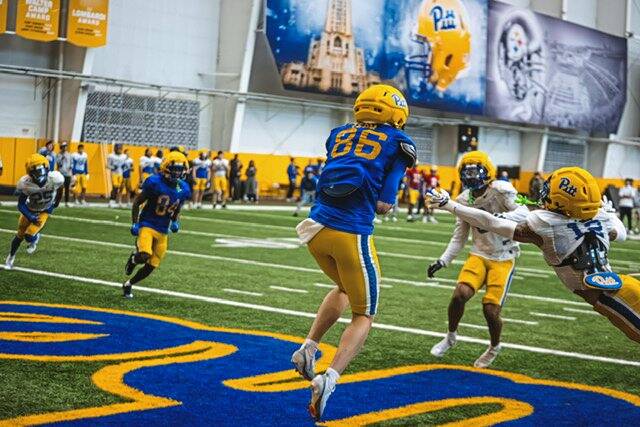
As Pitt gears up for spring ball, Davis will begin working with a tight ends room that lost the almost all of its production from a year ago.
Justin Holmes, Jake Overman, Josh Altsman and Malachi Thomas, who combined to catch 56 passes for 602 yards and eight touchdowns, are all gone.
Redshirt freshman Max Hunt, who had one grab for 20 yards last season, is the only returning tight end to have recorded a statistic.
Recognizing the need for help, Pitt brought in two transfers: Carson Kent (Oklahoma) and Elijah Lagg (UAB).
True freshman Wyatt Villarreal has also joined the program.
Kent, a 6-foot-4, 245-pounder, played three seasons at Kennesaw State (2022-24) before joining the Sooners in 2025.
While eventual third-team All-SEC selection Jaren Kanak got the lion’s share of reps and receptions at tight end, Kent was still able to sharpen his game on a squad that went 10-3 and made the College Football Playoff.
“That was a phenomenal experience, being on a team like that and going to the CFP,” Kent said. “The biggest thing I took from that is knowing what it takes to win. I told coach Narduzzi, coach Bell and everyone else — my one goal is to come and win a championship here. I know what it takes, and I’ve seen what it takes to be on a winning team and go that far. That’s one of the things I want to instill here with the team.
“I haven’t won a championship in all of my years playing football, and I’ve played since the second grade. That’s the one thing that I want. I could forget about all the individual goals; I want a ring on my finger.”
Lagg played offensive tackle throughout high school.
A desire to switch positions led him to enroll at Copiah-Lincoln Community College in Mississippi, where he honed his craft at tight end.
Leaving the junior college circuit after 14 games, he landed at UAB for 2025, where he made six starts and appeared in all of the Blazers’ 12 games, posting 20 catches for 164 yards.
“I’m a true hybrid tight end,” Lagg said. “I’m a physical run blocker and I’m a dynamic route runner, as well. I’ve got a vertical presence. I’m able to stretch the field. I’ve got quick explosion and shiftiness, as well. I’m trying to work on everything as much as I can, but I can certainly do some damage in both realms of the game.”
The days of tight ends being hand-in-the-dirt extra offensive linemen who occasionally catch passes are long gone.
Nowadays, players are expected to be able to do a wide variety of tasks in different packages.
During spring ball, Davis will look to develop versatility among his players.
“At tight end, it’s kind of unique, because you’re a little too small to block in the box,” Davis said. “You’re a little bit too slow in theory to separate on the perimeter in space, but you’re good enough at everything in order to do those jobs.
“At the end of the day, if we can’t be relied on in situations to move people, cover people up and block people with good fundamentals, we’re going to have a hard time being efficient on offense.”