
https://triblive.com/sports/penn-state-went-from-one-of-the-nations-top-recruiting-classes-to-the-worst-but-will-it-matter/
Penn State went from 1 of nation’s top recruiting classes to the worst, but will it matter?

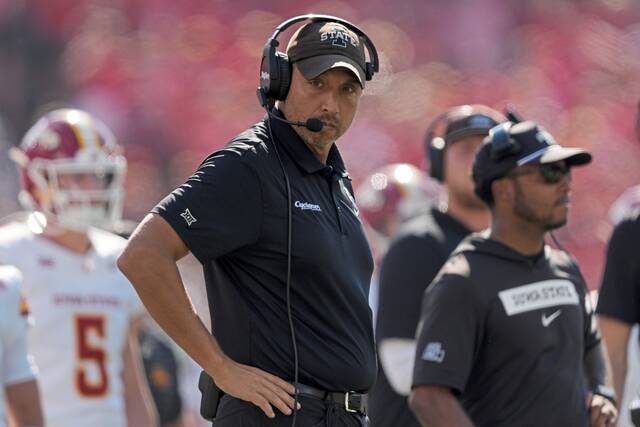
The first day of this week’s early national signing period came and went on Wednesday, when the bulk of the country’s top high school talent put pen to paper to continue their football careers.
Penn State — as it searched for James Franklin’s replacement as head coach — signed just two players.
Yes, two.
That gave the Nittany Lions the No. 153 class in the 247Sports Composite rankings. For reference, there are only 136 FBS teams.
FCS schools like Columbia, North Dakota State and South Dakota State were ranked above PSU.
While some fans online are applauding defensive end Jackson Ford and quarterback Peyton Falzone as immediate Penn State legends because of their willingness to sign before the school landed Matt Campbell to lead the team, that doesn’t soften the blow of such a historically bad signing day.
Not having a head coach in place at the time made a huge dent in Penn State’s efforts on the trail. The instability helped fizzle PSU’s recruiting class from 25 players — previously ranked among the top-15 classes nationally.
Notably, 11 one-time Nittany Lion pledges joined Franklin at his new home in Virginia Tech.
But does it really matter?
Sure, but not as much as it may seem on the surface.
For starters, Penn State and athletic director Pat Kraft are seeking a starkly different approach from Franklin’s over the past 11-plus years.
“Recruiting will always be a pillar here,” Kraft said Oct. 13. “We want someone who will attract elite talent, retain players in the NIL era and make Penn State a destination. This is also about the modern era of college football.”
Franklin and his staff were largely unwilling to set the NIL market on top high school prospects. Look no further than this summer’s misses on Joey O’Brien, Luke Wafle and others as evidence.
That can be looked to as one reason for so many departures from the recruiting class after Franklin’s firing, whereas other programs with coaching turnover experienced far less significant recruiting decline.
Franklin also preached till the bitter end (and at his introduction at Virginia Tech) that his program would not be a “big transfer portal team” but would rather fill holes with a small group of imports.
When Kraft pleaded for the next coach to maximize “elite” resources and to not be afraid to “evolve,” he was not-so-subtly marking a stark departure from Franklin’s philosophies.
Thus, the 2026 recruiting cycle was not the priority for Penn State. Having a coach in place by signing day may have meant the Lions signed more than two players, but even still, it wouldn’t have been the focus.
Kraft essentially said as much after firing Franklin.
“I’m just gonna be very honest, I am less worried about 2027 kids and more worried about my kids in the locker room right now,” he said. “That’s my focus.”
Penn State and Campbell will instead embrace the transfer portal like never before seen in Happy Valley. ESPN’s Max Olson dived into the most experienced transfer portal hauls among FBS teams entering the season, and the results generally speak for themselves.
No. 17 Virginia, No. 18 Arizona and No. 21 Houston were all among the top 10 in total snaps of experience added. Louisville, ranked for much of this season, was also in the top 10.
Penn State’s portal class of just eight players ranked 66th.
There’s also an argument for spending at the top of the market, as the four teams that gained the most career starts per transfer all finished in the top 25: Oregon, Indiana, Arizona and Virginia.
Among those six aforementioned portal-heavy successes, Oregon brought in just 11 transfers, but none of the others added fewer than 22.
That’s the model you should expect Penn State to try and follow. The transfer portal opens Jan. 2 for all teams, and the Nittany Lions will be busy.
But that’s just one reason why the 2026 signing class isn’t a huge concern. The others are a bit more straightforward.
First, there’s another high school signing period that opens in February. The large majority of top prospects prefer to sign in December, but there will be time for Penn State to sign high school players once Campbell gets up to speed.
Secondly, players who signed in December aren’t exempt from transferring this offseason. Take Ohio State quarterback Julian Sayin, a top Heisman Trophy contender this season, as a prime example.
Sayin signed with Alabama as a five-star prospect in the 2024 class and enrolled Jan. 10, 2024. By Jan. 24, he had transferred to the Buckeyes.
Standout freshman Cal quarterback Jaron-Keawe Sagapolutele followed a similar path, signing with Oregon but transferring to Cal before the winter was over.
Penn State can still go shopping for class of 2026 prospects over the next month.
And finally, Campbell could see a large number of Iowa State players and signees follow him to Happy Valley.
Signing just two players in the 2026 class is a bad look. It’s a failure on Penn State’s part for not having a head coach in place sooner, and there are undoubtedly obstacles to picking up those pieces moving forward.
But there are also myriad avenues to still putting a competitive — maybe playoff-level? — product on the field in 2026 that remain on the horizon.
Copyright ©2026— Trib Total Media, LLC (TribLIVE.com)