
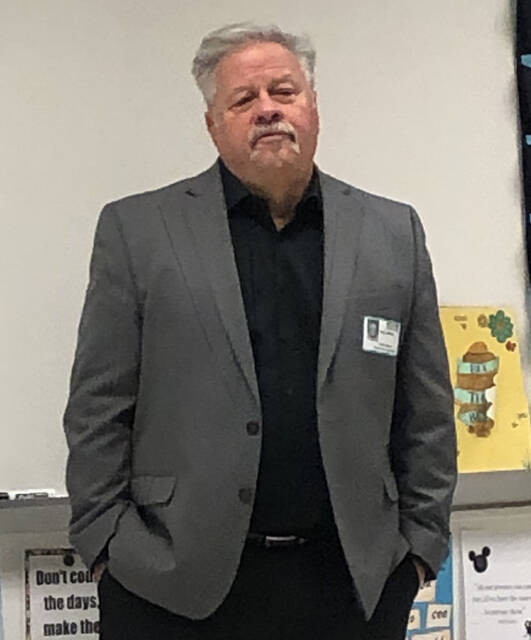


Editor’s note: The following story was submitted for the Shaler Area Student Section, a collaboration between TribLive and The Oracle, the student newspaper of Shaler Area High School.
Pittsburgh sports have changed a lot over the past 45 years, but one thing has managed to stay the same: Guy Junker.
Growing up in Baldwin, Junker had dreams of playing professional baseball, but, like most, he realized that playing baseball wasn’t a realistic career path.
Nonetheless, Junker knew he still wanted to have a career in sports. That’s when Junker’s father came to him with the idea of being a sports journalist. Junker took this idea and began writing in high school.
Junker’s first column covered Baldwin’s baseball team. Conveniently, Junker played on the team. So he would play in the games then write his column for the Purbalite, Baldwin High School’s student newspaper.
After high school, Junker attended and played baseball at Penn State University. Junker planned to join the staff of The Daily Collegian, Penn State’s student newspaper, but quickly learned it wouldn’t fit into his already busy schedule.
“When I got to Penn State, I was pretty busy. I was playing baseball, and I went to get on the student newspaper staff. Well, they wanted you to commit three nights a week and just sit there to watch what they do for an entire semester. I thought, ‘I don’t have enough time to do this,’ ” Junker said.
But thanks to his interest in the newspaper, Junker saw an advertisement for Penn State’s student radio station.
“I saw a little index card on a bulletin board that said student radio station is forming a staff, come to this meeting. I went to the meeting that Friday night, and I covered a Penn State soccer game. I did a report on the radio, and I never looked back to newspaper,” Junker said.
After college, Junker worked for Beaver Falls radio station WMBA. He quickly climbed the ranks and ended up covering the 1979 World Series.
“I was a year out of college, and I’ve never been back to a World Series. I’m glad I squeaked one in before I die, because I don’t think the Pirates will ever be in another one in my lifetime,” Junker said.
Junker’s talent largely aided his climb up the ladder in the sports media world, but he also pointed out how luck played into his success.
“I was lucky enough to get a couple of breaks. There were people that were more talented than me that never got the chance. I love sports, and I just wanted a job doing something in sports, and it worked out,” Junker said.
Just four years later, Junker was hired at WTAE where he would work alongside many Pittsburgh sports media icons, including Bill Hillgrove, Myron Cope and Stan Savran.
“They took me in when I was 25 years old. Bill (Hillgrove) being the Pitt guy, me being the Penn State guy, we always got along anyway. I had a lot of guidance and a lot of support as a young person getting started in this business,” Junker said.
Junker credits this time for creating some of his favorite memories while covering Pittsburgh sports. One of these memories came in 1988 when Pirates legend Willie Stargell was up for election into the National Baseball Hall of Fame.
Stargell was coaching for the Atlanta Braves at this time. Junker was sent to Atlanta to talk to him. Junker and a cameraman flew to Atlanta with very little information on where to find Stargell. They rented a car, got a map and started driving through Stone Mountain, Ga. In a stroke of luck, they found someone who knew where Stargell lived.
“I go to a gas station, and the clerk says, ‘Oh, he lives in an apartment complex. He has a Rolls Royce Silver Shadow parked right outside of his apartment. You’ll see it when you drive up.’ I knock on (Stargell’s) door, he opens his door, and he goes, ‘How’d you find me?’ ”
After a brief conversation, Stargell, who was not interested in the publicity, agreed to an interview. Junker had some time before the interview, so he wanted to be prepared in case Stargell was elected to the Hall of Fame.
“We were going past the liquor store, and I thought ‘I’m gonna get a bottle of champagne,’ just in case he gets in. We got back to Willie’s apartment at 7 o’clock, and the phone rang. So we turned the camera on, he answered the phone, and it was the head of the Baseball Writers Association of America — Stargell’s in the Hall of Fame. So I gave him the champagne,” Junker said. “The next morning, ESPN, CNN, everywhere, is using the picture of Willie Stargell popping a bottle of champagne that I bought him.”
When Junker wasn’t covering a feature story, he was working as a sports anchor. He covered sporting events from high school to pro levels.
“That was the neat thing about my job. I was doing something different every day. In any given week, at the height of my career, Friday night, I covered a high school game on TV. Saturday, I did the Penn State football story. Sunday, I’d be covering the Steelers game, whether they’re home or away, and then Monday through Friday, I’d be just anchoring the news on Channel 4,” Junker said.
Junker was the sports anchor for the 6 and 11 o’clock news. When he wasn’t on air, Junker would be researching and writing for his next on-air appearance.
“The little bit of time that you were on the air is the smallest part and the easiest part of the day. It’s doing the homework, knowing what you’re talking about, not just fluffing up your hair and going on TV,” Junker said.
Even though Junker had success early in his broadcasting career, Junker realized he still had a passion for writing and he found an unconventional way to get back into that part of sports media.
“I was doing a commercial for the Tribune-Review. They come out, shoot the commercial on the set, and at the end, the public relations person from the Tribune-Review asked, ‘Are you a subscriber to the Tribune-Review?’ I said, ‘No, I’m not.’ She asked, ‘What would it take for you to get a subscription?’ I said, ‘Give me a column,’ ”
The next day, the sports editor of the Tribune-Review at the time called Junker and asked if he was serious about writing.
“The next day, Dave Ailes called and asked, ‘Do you really want to write for us?’ I said, ‘Yeah.’ He told me, ‘You’ve got the column’, and I started the next Monday,” Junker said.
The job didn’t pay much, but that’s not why Junker wanted to write. Many of the sportswriters at the time looked down at people who worked in radio and television.
“I just wanted to prove to the rest of the ink-stained wretches at that time that I could write, as well as talk on television,” Junker joked.
Junker wrote his column for 17 years.
In 2022, Junker retired from his time on air. But Junker’s retirement didn’t last long. Not even a week into his retirement, the Pittsburgh Pirates called. They informed him that the longtime public address announcer at PNC Park, Tim DeBacco, was retiring. The Pirates offered Junker the position. Although surprised, Junker accepted the offer.
“I never thought the position would come open. Tim (DeBacco) is 10 years younger than me, and I retired from Channel 4 that same week,” Junker said.
Junker spends his time on the new job practicing names, studying lineups and working on different pronunciations. Although his retirement didn’t last long, Junker still gets time off while the Pirates are on road trips.
Junker spends his “retirement” watching baseball and playing golf while the Pirates are on the road.
From radio broadcasts and news broadcasts to newspaper columns and public address announcing, Junker has been a one of the most recognizable names in Pittsburgh sports for the past four decades, even if he doesn’t see it that way.
“I don’t view myself that way. I grew up with Stan (Savran) and Myron (Cope). Those guys were my idols, then I ended up working with them. I don’t really feel like I’m a part of that, but I’m really proud that people think that I am,” Junker said.